B2B liquidation is all about selling surplus inventory to recover cash, especially when traditional sales channels can’t move stock. The process evolves with economic cycles - growth, recession, and recovery - impacting how businesses handle excess goods. Here’s what you need to know:
- Growth Periods: Companies use "Just-in-Time" (JIT) inventory systems, focusing on seasonal overstock liquidation.
- Recessions: Demand drops, inventory builds up, and liquidation becomes critical for cash flow. Retail bankruptcies and aggressive offloading dominate.
- Recovery: Businesses shift to "Just-in-Case" (JIC) strategies, holding more inventory as a buffer. However, unmet demand forecasts often lead to further liquidation.
Key trends in 2026 include the rise of AI-driven platforms, steep initial discounts (up to 80%), and a growing focus on sustainability due to regulations like France’s anti-waste law. The global liquidation market, valued at $35 billion in 2024, is projected to more than double by 2034.
For businesses, leveraging technology like dynamic pricing tools and predictive analytics is essential to manage surplus efficiently. Meanwhile, buyers benefit from a booming secondary market, with opportunities in sectors like electronics, apparel, and home goods.
Quick Tip: Stay ahead by integrating liquidation into financial planning and using platforms like ForthClear for smarter, faster inventory management.
How Liquidating Unwanted Goods Became A $644 Billion Business
sbb-itb-bc600a0
How Economic Cycles Shape Liquidation Trends
How Economic Cycles Impact B2B Liquidation Strategies and Rates
Liquidation During Economic Growth
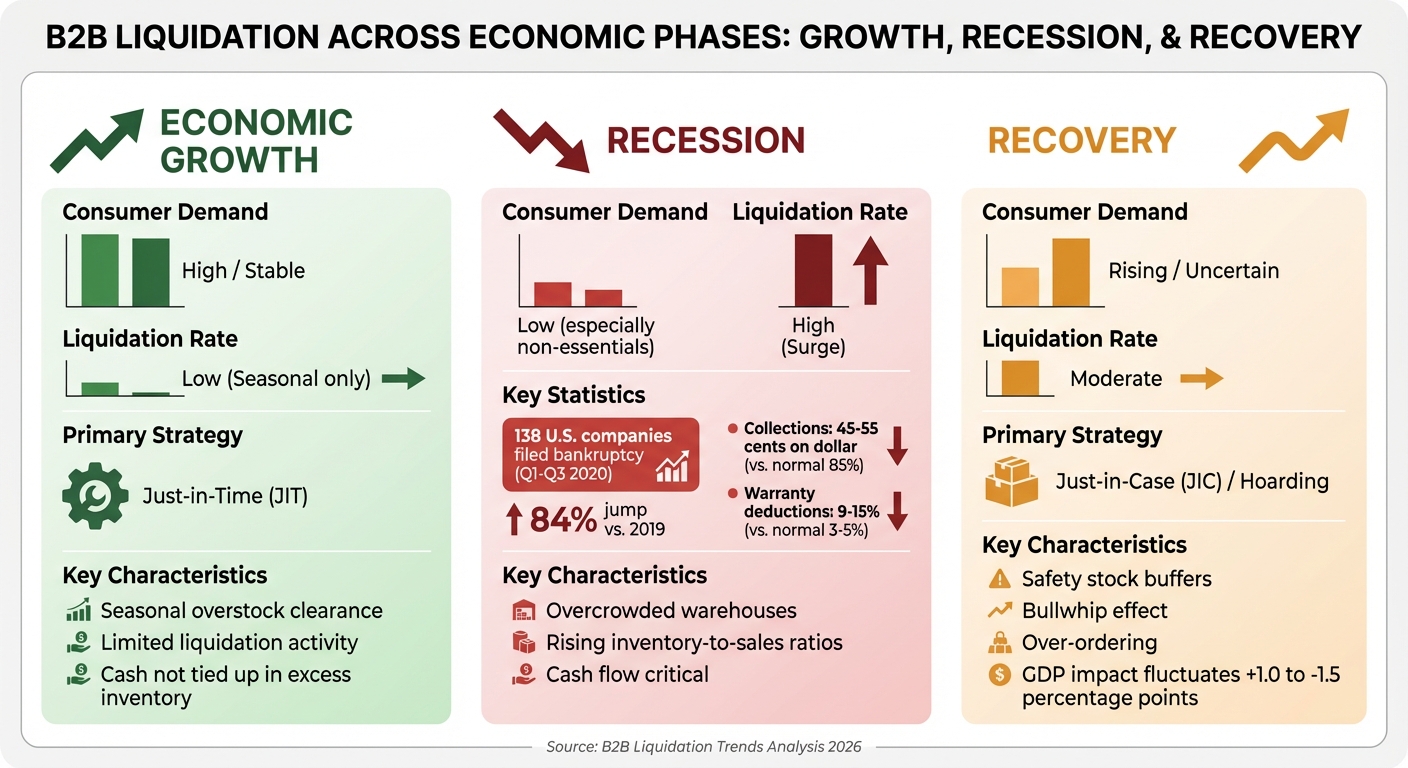
In times of economic growth, when consumer spending is robust, retailers often rely on Just-in-Time (JIT) inventory strategies to avoid tying up cash in excess stock. Liquidation during these periods is typically limited to clearing out unsold seasonal items, such as leftover holiday merchandise or end-of-season clothing. However, when economic conditions take a turn for the worse, these carefully managed practices can quickly unravel.
Liquidation During Recessions
Economic downturns bring a sharp decline in demand for non-essential goods - think electronics, toys, or home décor. This leaves retailers with an overstocked inventory that they struggle to sell through regular channels. During recessions, liquidation becomes a lifeline for maintaining cash flow.
The statistics paint a clear picture. Between Q1 and Q3 2020, 138 U.S. companies with assets exceeding $100 million filed for bankruptcy - an 84% jump compared to 75 filings during the same period in 2019. Q3 2020 alone saw 49 filings, a stark contrast to the average of 19 per quarter from 2005 to 2019. Fast forward to early 2025, major retailers like Forever 21, Joann Fabrics, Big Lots, and Party City filed for Chapter 11, flooding the secondary market with branded apparel, craft supplies, and home goods.
"We're witnessing a structural shift in retail - and when big players go down, they leave behind massive amounts of merchandise that still has real value in the secondary market."
- Allen R. Klein, President, Allen R. Klein Company
Rising inventory-to-sales ratios and falling revenue force retailers to act quickly. Overcrowded warehouses and escalating holding costs push companies to liquidate stock to free up both cash and space. However, liquidation often comes at a steep financial cost. Collections on accounts receivable during liquidation average only 45–55 cents on the dollar, far below the usual 85% assumption. Retailers may also demand warranty deductions as high as 9–15%, compared to the normal 3–5% range.
| Economic Phase | Consumer Demand | Liquidation Rate | Primary Inventory Strategy |
|---|---|---|---|
| Growth | High / Stable | Low (Seasonal) | Just-in-Time (JIT) |
| Recession | Low (Non-essentials) | High (Surge) | Aggressive Offloading |
| Recovery | Rising / Uncertain | Moderate | Just-in-Case (JIC) / Hoarding |
Liquidation During Recovery Periods
As economies recover, uncertainty around consumer demand leads many companies to switch from JIT to Just-in-Case (JIC) inventory models, holding extra stock as a buffer against future disruptions. But if demand doesn't grow as expected, these safety stocks can add to surplus inventory, requiring further liquidation.
The bullwhip effect is particularly pronounced during recovery. Companies often over-order supplies and hoard inventory out of caution, only to face painful destocking if demand slows. These inventory swings can impact GDP growth rates significantly, fluctuating between +1.0 and -1.5 percentage points.
"I don't think we've seen the last major bankruptcy this year... more product will enter the secondary channel. We're preparing for it - more space, more buyers, more deals."
- Allen R. Klein, President, Allen R. Klein Company
In this phase, companies may also reevaluate their work-in-progress (WIP) inventories, using surplus goods strategically to settle outstanding receivables. These cyclical shifts shape the strategies of B2B liquidators, helping them adapt to the constantly changing marketplace.
Regional and Industry Liquidation Trends
Liquidation Trends by Region
Liquidation patterns vary significantly across regions, shaped by local economic conditions and regulations. North America currently dominates the global liquidation services market, with revenues reaching about $2.3 billion in 2023. U.S. retailers reported a staggering $816 billion inventory surplus in 2023, with online return rates frequently exceeding 20%. The secondary market for returned goods in the U.S. is now valued at approximately $100 billion.
Business bankruptcies in the U.S. reached 6,574 in Q3 2025, marking a 15% increase over the 2019 average and the highest level since 2014. Factors like rising labor costs, higher refinancing rates, and ongoing digital transformation are driving this trend. Additionally, the effective tariff rate on U.S. imports has climbed to over 18%, the highest since 1930, adding extra strain on businesses managing imported inventory.
"2025 is shaping up to be the year where corporate defaults in the U.S. go noticeably above pre-pandemic levels for the first time."
- Marcos Carias, North America Economist, Coface
In Europe, sustainability laws are reshaping liquidation practices. France's 2022 anti-waste law, which bans the destruction of unsold goods, led to a 28% increase in liquidations within 18 months. Other EU countries, like Germany, are adopting similar measures, encouraging brands to use professional liquidation channels instead of disposal. Insolvencies in Europe are projected to rise by 3% in 2025, with a 7% decline forecasted for 2026 as markets stabilize.
Meanwhile, the Asia-Pacific region is grappling with a projected 7% rise in insolvencies for 2025. Singapore stands out with a forecasted 44% increase, the highest among monitored markets. Post-pandemic, electronics surpluses remain a major issue - China alone reported a $74 billion electronics surplus. At the same time, a growing middle class is driving demand for discounted goods. However, high operating costs and cash flow challenges are forcing businesses to liquidate assets more quickly.
| Region | Primary Liquidation Driver | 2025 Insolvency Forecast | Key Trend |
|---|---|---|---|
| North America | Inventory gluts & E-commerce returns | +5% | Growth in digital B2B auction platforms |
| Europe | Sustainability & Anti-waste laws | +3% | Move toward resale and circular practices |
| Asia-Pacific | Manufacturing surplus & demand | +7% | Electronics surplus and return logistics |
Liquidation Trends by Industry
In addition to regional differences, industries face unique liquidation challenges based on their products and market conditions.
For electronics, rapid obsolescence and compliance with data privacy regulations like GDPR and CCPA create significant hurdles. Despite these challenges, refurbished devices can recover up to 85% of their original value, while uncertified lots typically yield around 45% on B2B marketplaces. Additionally, about 43% of liquidated electronics are processed for parts, adding further salvage value.
The apparel industry faces high return rates, often exceeding 20% for online purchases, primarily due to size and fit issues. However, the sector benefits from a strong secondary market and frequent B2B auctions, which have grown by 40% annually. Recovery rates for apparel range between 22–34% of the original value.
Home goods and furniture present unique challenges due to their bulk and weight. The high costs of logistics and storage result in longer liquidation cycles, often involving 18-month staged discounting with 5% monthly price reductions. Meanwhile, the logistics sector is experiencing what experts call the "Great Freight Recession", with overcapacity and intense pricing pressure leading to significant job losses. By early 2026, nearly 600,000 U.S. logistics jobs were lost, including 30,000 roles at UPS alone.
In retail, the shift from physical stores to e-commerce continues to reshape the industry. Macy's plans to close 150 locations by 2026, reducing its total store count to 350. Industries like construction, retail, and services are currently seeing the highest rates of insolvencies.
"We appear to be reaching a point where demand is no longer solid enough to fully absorb the growth of production costs."
- Marcos Carias, North America Economist, Coface
Global insolvencies are expected to rise by 11% in 2024, followed by a 2% increase in 2025, before stabilizing in 2026. The global liquidation services market, valued at $35 billion in 2024, is projected to grow to $73 billion by 2034. These trends highlight the growing importance of flexible and regionally tailored liquidation strategies in an ever-changing economic landscape.
Current Liquidation Strategies in 2026
Aggressive Pricing and Faster Turnaround
With economic challenges mounting, liquidation strategies in 2026 have shifted to prioritize speed and impact. Instead of gradual markdowns, businesses are now opting for steep, immediate discounts. The old model of incrementally reducing prices - starting at 10%, then 20%, and so on - has fallen out of favor. Today, companies are offering 70% to 80% off wholesale prices right out of the gate to grab attention and move inventory before it loses more value.
Timing is everything. For example, summer goods that linger past July can lose 30% to 50% of their value. Secondary market buyers often wait until the last days of sales to make bulk purchases, leaving sellers scrambling. To counter this, some businesses are using a 6-month buffer strategy - holding onto liquidated inventory until the market stabilizes, then reselling it at margins up to 200% higher.
"Helping clients move product before the markdown spiral begins is where we add the most value."
- Allen R. Klein, President, Allen R. Klein Company
Strategic bundling has also become a go-to tactic. Pairing slow-moving items with popular ones boosts perceived value and clears out sluggish inventory faster. Tiered discounts, like offering 10% off one item and 20% off two, help increase overall order value while maintaining some level of profitability. This marks a shift in how businesses view liquidation - it's now part of early financial planning rather than a last-ditch effort to offload excess stock.
To make these rapid decisions, companies increasingly rely on advanced automation and data-driven tools.
Technology's Role in Liquidation
Technology has transformed how businesses manage surplus inventory, making the process faster and more efficient. AI-powered tools and predictive analytics now provide real-time market insights, helping businesses assess overstock risks and adjust prices dynamically. This means even smaller companies can bypass traditional liquidation firms and make informed decisions independently.
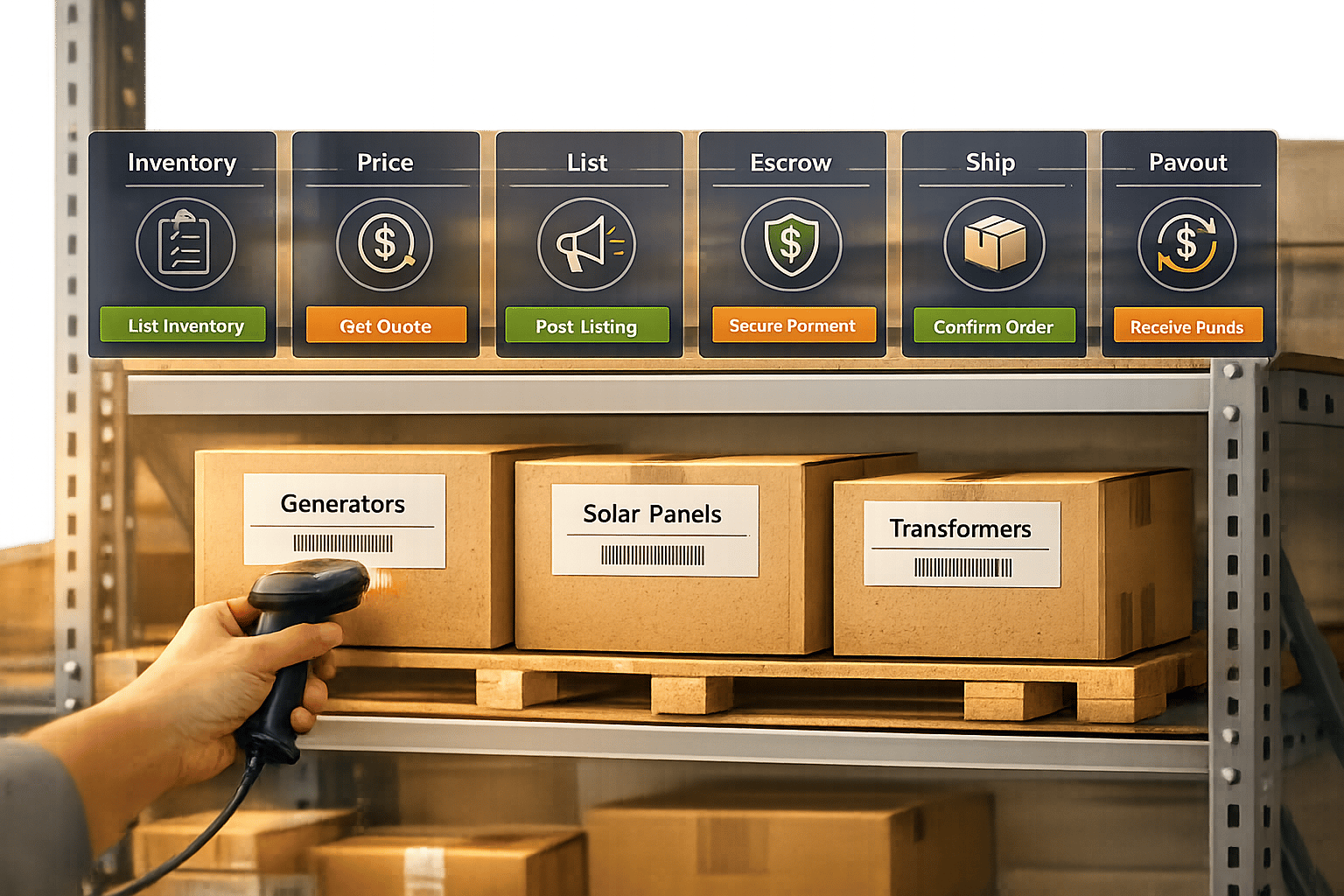
Dynamic pricing systems are a game-changer, allowing clearance prices to adjust in real time based on demand, competitor activity, and market conditions. Platforms like ForthClear simplify the process further. For instance, the system flags products that haven't sold in over 60 days and lets users list them for sale in minutes. Features like bulk upload tools with auto-image search save hours of manual work, while secure Stripe escrow payments ensure safe transactions. Additionally, real-time sales data enables regional reallocation, moving inventory to areas where demand is higher, minimizing markdown losses.
"One-size-fits-all clearance doesn't work anymore. We help clients move the right inventory to the right region at the right time."
- Allen R. Klein, President, Allen R. Klein Company
The U.S. liquidation market has now exceeded $700 billion annually, with technology driving much of this growth. Automated tools not only speed up transactions but also improve transparency. For instance, digital manifests now offer up to 98% accuracy, reducing risks for buyers and increasing trust.
These advancements also align with broader efforts to incorporate sustainable practices into liquidation strategies.
Sustainability in Liquidation Practices
Sustainability has become a critical component of modern liquidation strategies. More than ever, businesses are expected to balance profitability with environmental responsibility. A growing number of shoppers - 68% of resale buyers - seek liquidation channels specifically for their eco-friendly benefits. Companies are now tracking metrics like carbon footprint reduction and waste diversion to highlight their environmental efforts to stakeholders.
The adoption of circular economy principles has reshaped how businesses approach liquidation. Instead of treating excess inventory as an afterthought, companies now integrate it into the product lifecycle. Making recovery decisions earlier ensures better resale rates and avoids products becoming landfill waste.
Regional fulfillment is another priority. By focusing on local distribution, businesses reduce emissions from long-distance shipping. Diversifying resale channels - such as online marketplaces, B2B buyers, and discount retailers - keeps inventory circulating in the consumer market instead of heading toward disposal. The $100 billion secondary market for returned goods in the U.S. highlights the economic potential of these sustainable practices.
Regulations are also pushing companies toward greener strategies. France's 2022 anti-waste law, which bans the destruction of unsold goods, led to a 28% rise in liquidations within 18 months. Similar laws across the EU are making responsible liquidation a legal necessity. Businesses that adopt sustainable practices not only meet regulatory requirements but also enhance their brand reputation.
Key Takeaways for Merchants and Buyers
Adjusting Liquidation Strategies to Economic Conditions
Global business insolvencies are forecasted to climb 2.8% by 2026, with the United States seeing a 4% increase due to tariffs and a slowing economy. Even a modest 25-basis point rise in borrowing rates could lead to a 4% to 5% increase in defaults. For merchants, keeping a close eye on interest rate trends and adjusting liquidation strategies accordingly is essential.
Industries like construction, chemicals, and textiles are under particular strain. If you're in one of these sectors, focus on building cash reserves and tightening risk controls. As Coface economist Jonathan Steenberg points out, 2026 may bring a temporary pause in insolvency growth, but high debt levels and squeezed profit margins will persist.
"2026 should offer a respite rather than an improvement. The number of insolvencies will not fall: it will simply stop accelerating."
- Jonathan Steenberg, Economist, Coface
Given these challenges, merchants can leverage technology platforms like ForthClear to adapt quickly and stay ahead.
Using Platforms Like ForthClear
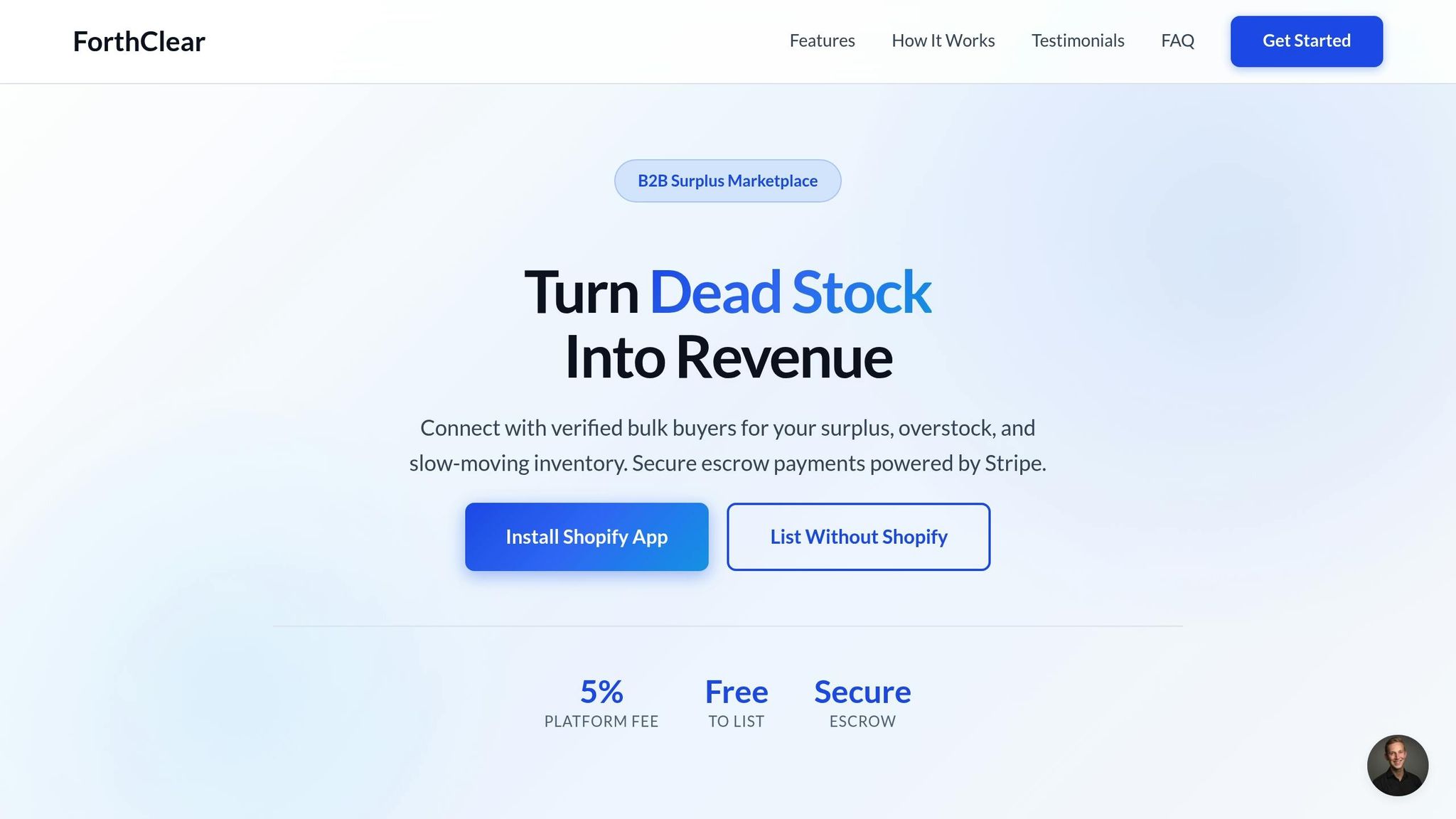
Technology is becoming a lifeline for businesses managing surplus inventory. Many small businesses are turning to AI-driven tools to boost efficiency. These platforms automate routine tasks, freeing up time for more strategic decisions.
ForthClear simplifies the liquidation process. Its Shopify integration identifies unsold inventory, while bulk upload tools with automatic image search reduce manual effort. Secure Stripe escrow payments ensure safe transactions, and real-time sales data helps merchants make smarter decisions about where to redirect inventory for better recovery rates.
Platforms offering predictive analytics and market insights are invaluable for avoiding risky inventory choices and minimizing losses. By automating repetitive tasks and using data to guide decisions, businesses can protect their margins and recover capital more effectively during uncertain economic times.
Preparing for Future Trends
Economic shifts and technological advances are reshaping liquidation practices. The global liquidation services market is set to grow at a 6.015% CAGR from 2025 to 2033. To remain competitive, businesses need to adopt forward-looking strategies, such as integrating surplus inventory management into their financial planning rather than treating it as an afterthought. For example, one apparel company boosted its sales of excess merchandise by 550% in just six months by using a tech-driven B2B resale platform.
Expanding your buyer network is another key strategy. Instead of relying on a single liquidator, consider platforms that connect you with a variety of resellers, exporters, and refurbishers. A Fortune 500 retailer, for instance, tripled its pricing on general merchandise inventory after adopting a new sorting method recommended by experts.
With J.P. Morgan projecting a 35% chance of a U.S. recession in 2026, it's crucial to prioritize liquidity. Maintain cash reserves and structure liquidation sales to ensure cash returns within 30 to 45 days, minimizing holding costs and the risk of dead stock. Businesses that adopt technology early, diversify sales channels, and make recovery decisions earlier in the product lifecycle will be better equipped to handle whatever economic challenges lie ahead.
FAQs
When should I liquidate instead of waiting for regular sales?
Freeing up your warehouse space and improving cash flow starts with addressing surplus inventory. When stock exceeds forecasted demand, becomes outdated, or starts tying up capital and storage costs, it’s time to take action. Prompt liquidation not only prevents further losses but also helps you make better use of your resources.
How do I choose between JIT and JIC inventory during recovery?
When choosing between Just-in-Time (JIT) and Just-in-Case (JIC) inventory strategies during recovery, it’s crucial to evaluate two key factors: how stable your supply chain is and how much your demand fluctuates.
- JIT focuses on reducing holding costs by ordering inventory only as needed. This approach works best when you have dependable suppliers and a predictable supply chain.
- JIC, on the other hand, emphasizes flexibility by maintaining safety stock. This is ideal for situations where supply chains are less stable or demand is harder to forecast.
For many, a hybrid strategy can strike the right balance. By combining safety stock (from JIC) with the efficiency of JIT practices, businesses can better navigate disruptions while staying responsive to market shifts.
What should I check before buying liquidation lots online?
Before buying liquidation lots online, it’s important to double-check a few key details to make sure your purchase is both secure and worthwhile. Start by ensuring the merchandise comes straight from the retailer’s reclamation center - this helps you avoid dealing with middlemen. Look into the lot’s seals and manifests to confirm the contents and their condition. Take some time to research the seller’s reputation by reading reviews. Lastly, make sure the lot’s size, condition, and shipping costs fit your requirements to avoid unnecessary risks.