The Rotterdam Convention governs international trade of hazardous chemicals to protect public health and the environment. If your business involves exporting or importing such chemicals, compliance is not optional - it’s mandatory. Here's what you need to know:
- Check Annex III: Confirm if your chemical is listed under the Rotterdam Convention's Annex III. Use the CAS number to verify and download the Decision Guidance Document (DGD) for detailed regulations.
- Secure Import Approvals: Before shipping, ensure the importing country has provided explicit consent or conditions for the trade. Check the Import Responses Database or the latest PIC Circular.
- Follow Labeling Rules: Use internationally recognized labeling standards like the Globally Harmonized System (GHS) and provide accurate Safety Data Sheets (SDS) in the importing country’s language.
- Track Updates: Regulations are updated regularly. Monitor the PIC Circular (June and December), Chemical Review Committee (CRC) recommendations, and Conference of the Parties (COP) decisions.
Non-compliance can lead to trade bans, legal penalties, and reputational damage. Stay informed and organized to ensure smooth operations in hazardous chemical trade.
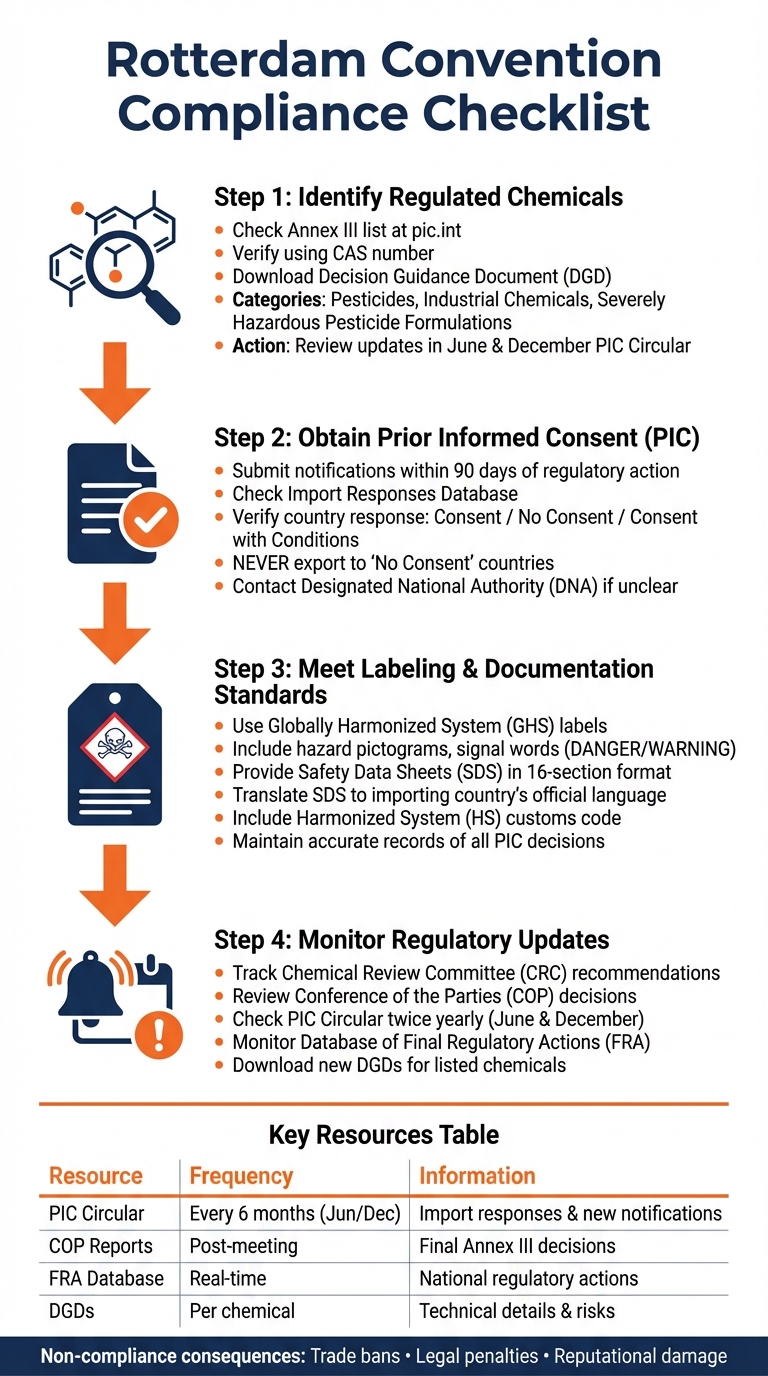
Rotterdam Convention Compliance Checklist for B2B Chemical Trade
Identifying Regulated Chemicals in Annex III
Review the Annex III Chemical List
Start by confirming whether your chemical is included in the Annex III list at pic.int. This list outlines all substances regulated under the Prior Informed Consent (PIC) procedure. Annex III is divided into three categories: Pesticides, Industrial Chemicals, and Severely Hazardous Pesticide Formulations.
Check the chemical's CAS number against the Annex III database. Once confirmed, download the Decision Guidance Document (DGD) linked to the chemical.
"For each chemical listed in Annex III of the Rotterdam Convention, a decision guidance document (DGD) is prepared... The DGDs are intended to help governments assess the risks connected with the handling and use of the chemical and to make more informed decisions about its future import and use".
The DGD provides critical details, including the chemical's properties, hazard classifications, and the reasoning behind its regulation. Be sure to review the document thoroughly, as some listings might only apply to specific formulations or industrial uses. Also, keep an eye on periodic updates to the Annex III list.
Check for Recent Updates
The Annex III list is updated regularly as new chemicals are added based on recommendations from the Chemical Review Committee (CRC) and decisions made during the Conference of the Parties (COP). The Secretariat publishes a PIC Circular twice a year - in June and December - highlighting updates to Annex III and summarizing import responses from participating countries.
Make it a habit to check pic.int for updates. When a chemical is newly added, a fresh DGD is created and distributed to all Parties. Additionally, verify the import statuses of destination countries using the Import Response database. This step is crucial to avoid customs issues or legal penalties tied to non-compliance.
Staying informed about chemical listings and updates is a key part of securing prior informed consent and ensuring proper labeling and documentation practices.
sbb-itb-bc600a0
Obtaining Prior Informed Consent (PIC)
Submit Notifications of Final Regulatory Actions
When your country bans or heavily restricts a chemical for health or environmental concerns, your Designated National Authority (DNA) must notify the Rotterdam Convention Secretariat in writing within 90 days of the final regulatory action taking effect. According to the Rotterdam Convention Secretariat:
"Each Party that has adopted a final regulatory action shall notify the Secretariat in writing of such action."
To do this, you need to complete the official "Form for Notification of Final Regulatory Action." This form should include details like the chemical's CAS number, trade names, specifics of the regulatory action, and a summary of the associated risks. The Secretariat will review your submission within six months. Once validated, the notification will appear in the PIC Circular, which is distributed to all Parties every June and December.
Secure Import Responses
Before exporting any chemical listed in Annex III, check the import response from the destination country. Each Party must provide an import response for every Annex III chemical, indicating one of three options: Consent, No Consent, or Consent under conditions. To find this information, visit the Import Responses Database at pic.int or review the most recent PIC Circular. If the response is "Consent under conditions", make sure you understand and comply with those conditions before proceeding. If no response is available, contact your DNA to determine whether explicit consent is required or if interim rules apply.
"For each chemical listed in Annex III of the Convention and subject to the PIC procedure, all Parties are required to take a decision on whether or not they will allow future import of the chemical." - Rotterdam Convention Secretariat
Avoid Exports to Countries with Import Bans
Never export an Annex III chemical to a country that has issued a "No Consent" response. It is the exporter’s responsibility to ensure that shipments align with the importing Party's decision.
"The exporting Party must ensure that exports do not occur contrary to the import decision of the importing Party." - Rotterdam Convention Secretariat
Additionally, if a chemical is banned or severely restricted in your own country but is not yet listed in Annex III, you must send an Export Notification to the importing country before the first export of the year. Make sure you have up-to-date contact information for the importing country's DNA to ensure the notification reaches the correct official. Also, verify that your labeling and documentation meet the requirements outlined in the PIC procedures.
The Rotterdam Convention Prior Informed Consent Procedure
Meeting Labeling and Documentation Requirements
Once you've validated import responses, it’s crucial to ensure your product labeling and documentation meet the necessary standards. Proper labeling and thorough documentation not only satisfy legal requirements but also help communicate potential risks throughout the supply chain.
Hazard Labeling and Packaging Standards
For every Annex III chemical, labels must clearly convey risks. The Rotterdam Convention mandates that labels adhere to international standards. Article 13, Paragraph 3 of the Convention specifies:
"Each Party shall require that chemicals listed in Annex III and chemicals banned or severely restricted in its territory are, when exported, subject to labelling requirements that ensure adequate availability of information with regard to risks and/or hazards to human health or the environment, taking into account relevant international standards."
To comply, use the Globally Harmonized System (GHS) for labeling. This includes hazard pictograms, signal words like DANGER or WARNING, hazard (H) statements, and precautionary (P) statements. Labels should align with Section 2.2 of the accompanying Safety Data Sheet (SDS). Additionally, shipping documents must include the correct Harmonized System (HS) customs code, as assigned by the World Customs Organization, to help customs officials quickly identify regulated chemicals.
Include Safety Data Sheets (SDS)
Clear labeling should always be paired with accurate, up-to-date Safety Data Sheets (SDS). Provide an SDS for each Annex III chemical or any chemical banned or heavily restricted in your country. The SDS must follow an internationally recognized 16-section format for workplace chemicals. The Convention highlights:
"The information on the label and on the safety data sheet should, as far as practicable, be in one or more of the official languages of the importing Party."
Translate the SDS into the official language of the importing country to avoid customs delays and ensure proper handling. If the chemical is registered under REACH and exceeds 10 tonnes per year, you may also need to supply an extended SDS (eSDS) with exposure scenarios attached. Check that Section 14 of your SDS matches the transport labels on your packaging, ensuring hazard diamonds and UN numbers are consistent.
Maintain Accurate Records
Keep detailed records of all Prior Informed Consent (PIC) decisions, export notifications for non-Annex III chemicals, and communications with trade partners. If an importing Party doesn’t confirm receipt within 30 days, send a second notification and document this step. Retain all SDSs, labels, shipping documents, and HS codes for compliance audits. These record-keeping requirements remain in effect until a chemical is formally added to Annex III and the importing Party’s response is distributed by the Secretariat.
Monitoring Updates and Staying Informed
Staying compliant with the Rotterdam Convention isn’t a one-time task - it’s an ongoing process. As the Convention updates its chemical reviews and import responses, keeping up-to-date is essential to avoid potential trade issues.
Follow Chemical Review Committee Recommendations
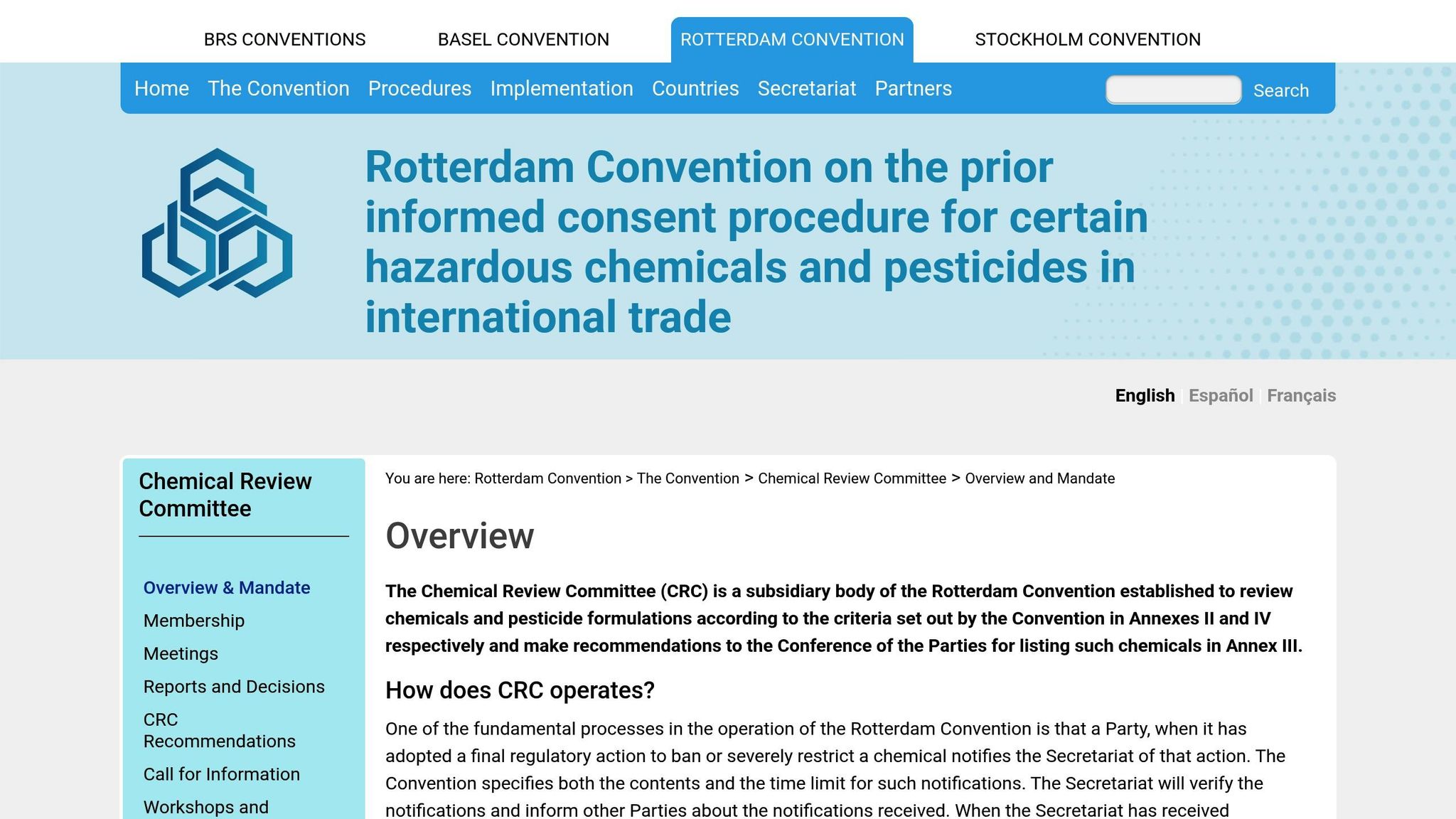
The Chemical Review Committee (CRC) plays a vital role in the Convention. This group of 31 government-appointed experts evaluates notifications about banned or severely restricted chemicals and advises the Conference of the Parties (COP) on which chemicals should be added to Annex III. According to the Rotterdam Convention Secretariat:
"The Chemical Review Committee (CRC) is a subsidiary body of the Rotterdam Convention... its main function is reviewing notifications and proposals from Parties and make recommendations to the Conference of the Parties on the listing of chemicals in Annex III."
Chemicals flagged by the CRC are often high-risk candidates for future trade restrictions. To stay ahead, regularly check the Database of Notifications of Final Regulatory Actions (FRA) for updates on chemicals restricted by individual countries - these often signal the next additions to Annex III. Once a chemical is listed in Annex III, download its Decision Guidance Document (DGD) for technical details and the reasoning behind its inclusion. Reviewing CRC recommendations and COP reports regularly ensures you’re prepared for upcoming regulatory changes.
Track Conference of the Parties (COP) Decisions
The Conference of the Parties (COP) finalizes decisions on Annex III updates and compliance obligations. After each COP meeting, it’s crucial to review the official "Reports and Decisions" page to identify new legal requirements and effective dates for Annex III amendments. These decisions build on CRC recommendations, making them key to understanding your compliance responsibilities.
Another essential resource is the PIC Circular. Published twice a year, this document provides updates on import responses and regulatory changes. The Rotterdam Convention Secretariat highlights its importance:
"The PIC Circular is a key document in the implementation of the Rotterdam Convention... It is published every six months, in June and December."
Make it a habit to review the PIC Circular in June and December. This ensures you’re aware of the latest import responses and regulatory actions, as countries can update their consent decisions at any time.
| Source | Frequency | Key Information Provided |
|---|---|---|
| PIC Circular | Every 6 Months (June/Dec) | Import responses, new notifications of regulatory action, and proposals for hazardous formulations. |
| COP Reports | Periodic (Post-Meeting) | Final decisions on Annex III listings and amendments to Convention procedures. |
| FRA Database | Ongoing/Real-time | National-level regulatory actions that may lead to future global listings. |
| DGDs | Per Chemical Listing | Technical details, health/environmental risks, and guidance for Annex III chemicals. |
Conclusion and Key Takeaways
With participation from over 160 countries, adhering to the Rotterdam Convention not only ensures compliance but also supports global efforts to enhance safety and informed decision-making in chemical trade.
Compliance Steps Summary
To meet the Convention's requirements, here’s a quick recap of the key actions:
- Identify regulated chemicals: Check Annex III to confirm if your chemicals are listed and stay updated on any changes (Refer to "Identifying Regulated Chemicals in Annex III").
- Obtain Prior Informed Consent (PIC): Submit notifications of final regulatory actions and ensure import responses are secured before shipping. Avoid exporting to countries that have issued "no consent" responses (Refer to "Obtaining Prior Informed Consent (PIC)").
- Follow labeling and documentation standards: Use proper hazard labels, include current Safety Data Sheets (SDS) with shipments, and maintain detailed transaction records (Refer to "Meeting Labeling and Documentation Requirements").
- Stay informed on regulatory updates: Regularly review updates to ensure ongoing compliance (Refer to "Monitoring Updates and Staying Informed").
"The Rotterdam Convention is an international treaty designed to facilitate informed decision-making by countries with regard to trade in hazardous chemicals."
The Importance of Continuous Monitoring
The Rotterdam Convention operates within a constantly evolving framework. As new substances are reviewed by the Chemical Review Committee and countries revise their import consent decisions, today’s compliance measures may need adjustments tomorrow. Keeping a close eye on updates, such as PIC Circulars and COP decisions, is critical to maintaining compliance and ensuring your processes remain aligned with global standards.
FAQs
What should I do if a chemical I export is added to Annex III of the Rotterdam Convention?
If a chemical you export is newly added to Annex III, there are a few key actions you’ll need to take to comply with the Rotterdam Convention. First, prepare a Decision Guidance Document (DGD) and distribute it to all relevant Parties. This document is essential for informing stakeholders about the chemical and its safe handling.
Next, check the import decisions of the countries receiving your exports. Make sure your shipments match their stated requirements. If an importing country has issued a negative response or explicitly stated they do not accept the chemical, you must immediately stop exporting it to that destination.
Taking these steps ensures your operations stay compliant and supports responsible trade practices for hazardous chemicals.
What steps should I take to ensure my labels and documents comply with the Rotterdam Convention?
If you're working with hazardous chemicals, it's essential to follow the Rotterdam Convention's rules. A key part of this is ensuring your labels and documents are clear and accurate. These should include important details like the chemical's identity, instructions for safe handling, and its regulatory status. Double-check that all this information is current and aligns with the Convention's guidelines.
For chemicals listed in Annex III, you’ll need to prepare and share Decision Guidance Documents (DGDs). These documents help assess potential risks and ensure proper labeling practices. If you're exporting chemicals that are restricted or banned, make sure to send export notifications before shipping. Also, confirm that every document reflects the latest regulatory requirements.
Staying updated on any changes to the Convention is critical. This helps you keep your processes compliant and avoid unnecessary risks.
What happens if a business doesn't comply with the Rotterdam Convention?
Failing to follow the Rotterdam Convention can lead to serious repercussions. Companies might encounter trade restrictions, hefty fines, or even legal actions for breaching international rules. Beyond these penalties, non-compliance poses significant dangers to human health and the environment, particularly when hazardous chemicals are mishandled.
To steer clear of such risks, businesses must align with the convention's guidelines and adopt stringent safety and regulatory measures in their trading activities.