The auto industry is shifting from a waste-heavy model to a circular economy - focused on reusing, remanufacturing, and recycling parts. This approach could cut emissions by up to 75% and reduce resource use by 80% per passenger kilometer by 2030. However, challenges like high costs, technical hurdles, and limited recycled material availability slow progress.
Key Takeaways:
- Environmental Gains: Refurbishing engines generates only 15% of the emissions compared to making new ones. Recycling EV batteries conserves critical materials like cobalt and nickel.
- Cost Savings: Remanufacturing parts can lower production costs by 40–60% and offer consumers 45–65% cheaper alternatives.
- Challenges: High reverse logistics costs, complex vehicle designs, and material quality loss during recycling create roadblocks.
- Solutions: Digital platforms like ForthClear simplify inventory management, improve traceability, and connect buyers with surplus parts.
Circular practices promise a cleaner, cost-efficient future, but scaling them requires collaboration, advanced technology, and regulatory support.
1. Benefits of Circular Economy in Auto Parts
Environmental Impact
Switching from a linear to a circular economy in auto parts delivers measurable environmental benefits. For example, refurbishing an engine generates just 15% of the emissions required to produce a new one. Similarly, remanufacturing critical components like combustion engines can cut Global Warming Potential by up to 79%. These reductions come from minimizing the need for mining and processing raw materials.
Electric vehicle (EV) battery production is a prime example of how circular practices can address sustainability challenges. In December 2022, Northvolt, a Swedish battery developer partly owned by Volkswagen, created battery cells using recycled nickel, manganese, and cobalt. These materials were recovered from waste, and the company has already secured over $55 billion in contracts from major clients like Volvo and Polestar. Meanwhile, Bolder Industries achieved over a 90% reduction in greenhouse gas emissions and water usage by producing carbon black alternatives from old tires by 2025. In Europe, remanufacturing keeps approximately 150,000 tons of materials in use every year, ensuring access to scarce resources like rare-earth elements and other Critical Raw Materials. These environmental gains also set the stage for substantial economic opportunities.
Economic Implications
The cost savings from circular practices aren’t just good for the planet - they’re also good for business. Remanufacturing can lower production costs by 40% to 60% compared to manufacturing new parts, boosting profit margins. On the consumer side, remanufactured parts are typically 45% to 65% cheaper than new ones, and they still come with warranties. By 2030, the automotive industry could unlock between $475 billion and $810 billion in economic value through remanufacturing and material recovery.
"Remanufacturing can reduce costs by 40 to 60 percent, directly boosting margins versus newly manufactured parts." - McKinsey
The scale of these efforts is already significant. In 2024, LKQ Corporation processed 735,000 vehicles worldwide and sold nearly 12 million salvaged and remanufactured parts. This thriving secondary market not only reduces reliance on volatile raw material supplies but also helps mitigate risks from shortages.
Operational Feasibility
Modern technology has made circular practices more practical and efficient than ever. For instance, Novelis implemented advanced scrap-sorting systems in 2024 to recover high-quality aluminum from old vehicles, which is then reintegrated into the production chain. Tools like AI-driven scrap sorting, IoT-enabled predictive maintenance, and blockchain for tracking materials in real time are revolutionizing how companies manage their resources.
The market for remanufactured automotive components is expected to grow significantly, from $27 billion in 2022 to $42 billion by 2030. Renault Group's "Refactory" initiative, launched in September 2025, focuses on refurbishing vehicles to extend their lifespan. The company has also committed to increasing vehicle usage rates by at least 20% through innovative mobility services. With recycling efficiency for vehicles projected to rise from 78% today to 97% by 2040, circular operations are becoming not only feasible but also a standard part of the automotive industry.
sbb-itb-bc600a0
2. Challenges of Circular Economy in Auto Parts
Economic Implications
The promise of savings through circular practices is appealing, but achieving profitability is no easy feat. Collecting and processing used auto parts requires hefty initial investments in specialized facilities. On top of that, the unpredictable timing and condition of incoming used parts create logistical headaches. These issues often lead to higher costs from overtime labor or expedited shipping. Pricing these parts is another hurdle. Differences in product age, condition, and limited quantities make it nearly impossible to gauge price elasticity accurately.
"Remanufacturing undoubtedly makes logistics, pricing, and operations more complex" - McKinsey
Adding to the complexity, the market for high-quality secondary materials is both limited and volatile, leading to long-term sourcing challenges. Navigating these financial and operational difficulties requires advanced systems to maintain profit margins. These hurdles, both economic and logistical, make it tough for businesses to fully embrace circular models.
Operational Feasibility
Modern vehicles pose significant technical challenges for recycling. Each car contains around 30,000 components, many of which are made from multi-material composites or are permanently fused together. For instance, vulcanized rubber in tires forms chemical bonds that cannot be reversed, while fiber-reinforced plastics degrade during recycling, losing their original properties . These limitations mean that over 80% of end-of-life plastics in the U.S. end up in landfills.
Additionally, the shift from mechanical to electronic components complicates remanufacturing. Tasks like software updates, sensor testing, and electronic diagnostics require specialized skills, clean-room environments, and advanced training. Robert Casper from the University of Bayreuth highlights the confusion surrounding the classification of used parts:
"The interpretation of the status of cores is often a matter of discussions. Can cores be seen as a used spare part? As old metal? As a scrap part? As hazardous waste?"
This lack of clarity makes logistics and regulatory compliance even more challenging. While Europe collects 89% of end-of-life materials for recycling, inefficiencies reduce the effective recycling rate to 78%. These technical and regulatory hurdles create additional challenges for circular practices.
Environmental Impact
Circular practices often come with environmental trade-offs. Recycling facilities can generate pollution and must handle hazardous materials like oils and battery chemicals from end-of-life vehicles. Additionally, many materials undergo "downcycling", where their quality diminishes, limiting their reuse in automotive applications .
Switching to bio-based materials isn't a perfect solution either. For example, while natural rubber can enhance biodegradability, its rising demand has contributed to deforestation in Southeast Asia. Electric vehicles, though offering lower lifetime emissions, have a more carbon-intensive production process due to the mining of battery metals and their heavier weight.
Currently, only 3% of plastics used in car manufacturing are recycled into new products. Mechanically recycled polypropylene, for instance, loses 15% to 20% of its strength compared to virgin materials. The EU's upcoming requirement for new vehicles to include 25% recycled plastic by 2038 will demand 1.4 billion kilograms annually, but projections suggest only 800 million kilograms of suitable recyclates will be available. These challenges highlight the environmental complexities tied to circular practices in the automotive industry.
Inside BMW's Circular Economy: Old Materials Into New Parts
Pros and Cons Comparison
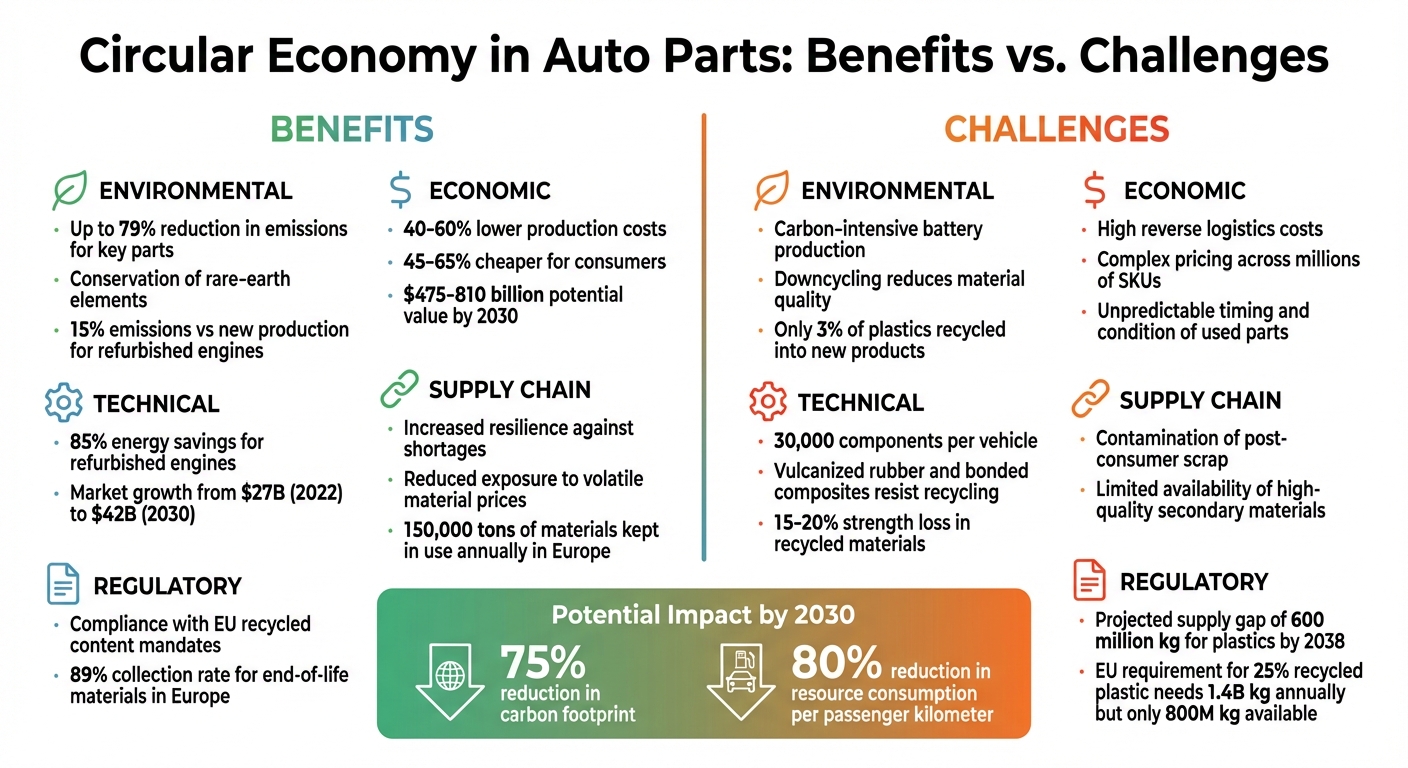
Circular Economy in Auto Parts: Benefits vs Challenges Comparison
Balancing the advantages and challenges of circular economy practices in auto parts is essential for progress. These practices offer impressive financial and environmental benefits. For instance, remanufacturing can slash production costs by 40–60% and save consumers 45–65% compared to buying new parts. On top of that, remanufacturing combustion engines can cut global warming potential by up to 79% - a big win for emissions reduction.
However, implementing these strategies isn't without hurdles. One major issue is the unpredictable availability of "cores" (used parts), making inventory management and pricing difficult. Additionally, the intricate material composition of modern vehicles - like vulcanized rubber, which is tough to recycle - adds another layer of complexity.
Here’s a breakdown of the key trade-offs:
| Criteria | Benefits | Challenges |
|---|---|---|
| Environmental | Up to 79% reduction in emissions for key parts; conservation of rare-earth elements | Carbon-intensive battery production; downcycling reduces material quality |
| Economic | 40–60% lower production costs; reduced exposure to volatile material prices | High reverse logistics costs; complex pricing across millions of SKUs |
| Technical | 85% energy savings for refurbished engines | Vulcanized rubber and bonded composites resist high-value recycling |
| Supply Chain | Increased resilience against shortages and price volatility | Contamination of post-consumer scrap limits recycled content purity |
| Regulatory | Compliance with EU recycled content mandates | Projected supply gap of 600 million kg for plastics by 2038 |
These trade-offs highlight the challenges and opportunities in the sector. Circular strategies have the potential to cut the auto industry's carbon footprint by 75% and reduce resource consumption by 80% per passenger kilometer by 2030. But reaching these ambitious targets will require significant investments in advanced technologies, workforce skills, and collaborative partnerships. The road ahead is steep, but the potential rewards make it worth the effort.
How Platforms like ForthClear Support Circular Economy

Digital platforms are reshaping the auto parts industry by making the circular economy more accessible. They connect manufacturers, dismantlers, recyclers, and buyers, creating a network that keeps materials in circulation longer. This is especially critical in an industry with millions of unique SKUs, where matching surplus inventory with demand has often been a costly and inefficient process.
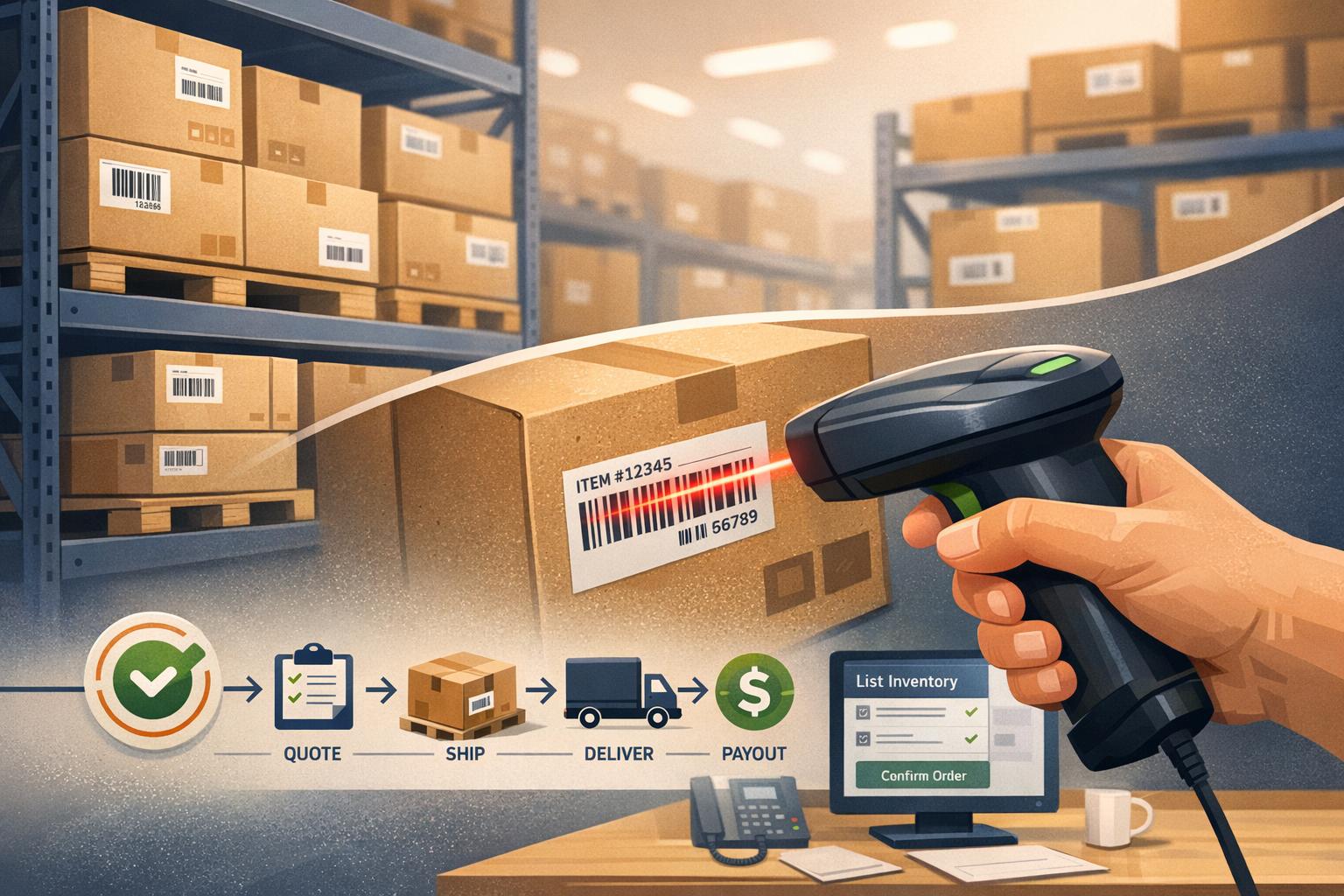
ForthClear simplifies surplus inventory management by identifying dead stock - parts unsold for over 60 days - and automating their listing. For suppliers dealing with outdated inventory, this automation eliminates much of the manual work by connecting them with verified bulk buyers. Transactions are secured through a Stripe escrow system, which only releases funds after delivery is confirmed. This not only ensures safe transactions for high-value remanufactured parts but also provides suppliers with better insights into their inventory.
The platform also helps prevent unnecessary production of new parts. With real-time inventory visibility, buyers can quickly find surplus components through digital catalogs, reducing the need to manufacture new ones. This efficiency supports the growth of the remanufacturing industry, which is expected to increase from $27 billion in 2022 to $42 billion by 2030. Additionally, bulk pricing features encourage larger orders, improving fulfillment rates and further optimizing the supply chain.
Traceability is another major benefit. Digital tools enable real-time tracking of product lifecycles and material flows, helping companies comply with regulations like the EU Battery Passport. ForthClear's supplier verification protocols also enhance "core authentication", which tracks the history and condition of remanufactured components. This builds trust in used parts, making it more likely they’ll be reintegrated into the supply chain - a crucial element for circular systems.
While large suppliers gain operational efficiencies, smaller operators also benefit significantly. ForthClear provides access to robust datasets, helping smaller players optimize bid pricing for salvage vehicles and expand their market for recovered parts. This approach aligns with trends like prioritizing recycled materials over virgin inputs and modular design strategies. By simplifying reverse logistics with transparent transactions and direct communication between buyers and sellers, platforms like ForthClear reduce the barriers that have traditionally hindered circular economy adoption in the automotive sector.
Conclusion
Circular economy practices in auto parts are no longer just an option - they're a pressing requirement driven by regulatory, environmental, and economic factors. The industry faces the challenge of balancing immediate actions, such as closed-loop aluminum recovery, with long-term investments in areas like advanced battery recycling and the development of bio-based materials.
The potential impact of circular strategies is hard to ignore. For instance, refurbishing an engine generates only 15% of the emissions compared to producing a new one. These approaches not only conserve resources but also significantly reduce emissions. However, challenges like the predicted shortfall in recycled plastics - estimated to be about 600 million kilograms annually by 2038 - and the need for specialized expertise, such as material scientists, highlight the complexities of scaling these efforts.
Collaboration across the ecosystem is the key to success. Recent industry partnerships have shown that coordinated efforts between manufacturers, dismantlers, recyclers, and digital platforms can overcome significant hurdles. These partnerships demonstrate how collective action can drive meaningful progress toward circularity.
Digital tools play a crucial role in enabling these collaborations. Technologies like battery passports, blockchain, and AI-driven sorting systems streamline supply chains and ensure compliance with regulatory requirements. Platforms such as ForthClear also contribute by connecting surplus inventory with vetted buyers, reducing waste and supporting sustainable remanufacturing practices.
The automotive sector contributes roughly 10% of the global material footprint. By adopting strategies like design for disassembly, cross-functional collaboration, and strategic material flow mapping, companies have the potential to unlock economic value estimated between $475 billion and $810 billion by 2030. Transitioning from a "take-make-dispose" approach to one centered on value retention is not just a step forward - it's a necessity for building a resilient and profitable future in the face of growing material and regulatory pressures.
FAQs
What counts as remanufactured vs. recycled auto parts?
Remanufactured auto parts are carefully restored to their original working condition. This involves steps like disassembly, thorough cleaning, and reassembly, often ensuring they meet established industry standards. In contrast, recycled auto parts focus on breaking down used components or materials into raw materials for other manufacturing purposes, without necessarily preserving or restoring the part's original functionality.
Why are “cores” so hard and expensive to source?
Cores can be tricky and expensive to obtain because their availability tends to be unpredictable. On top of that, handling the reverse logistics of used parts introduces another layer of complexity. This process demands a high level of trust, clear communication, and traceability - all of which drive up costs. These challenges make it tough to simplify operations and maintain a consistent supply of cores needed for remanufacturing.
How do traceability tools help meet recycled-content rules?
Traceability tools play a key role in ensuring companies comply with recycled-content regulations by tracking materials across the supply chain. They confirm both the origin and composition of recycled materials, helping businesses align with legal requirements and environmental guidelines.
Beyond compliance, these tools simplify data collection and reporting processes for audits. They ensure recycled materials meet quality standards and regulatory benchmarks, minimizing the risk of non-compliance. Additionally, they foster greater transparency with consumers and regulators, building trust and accountability.