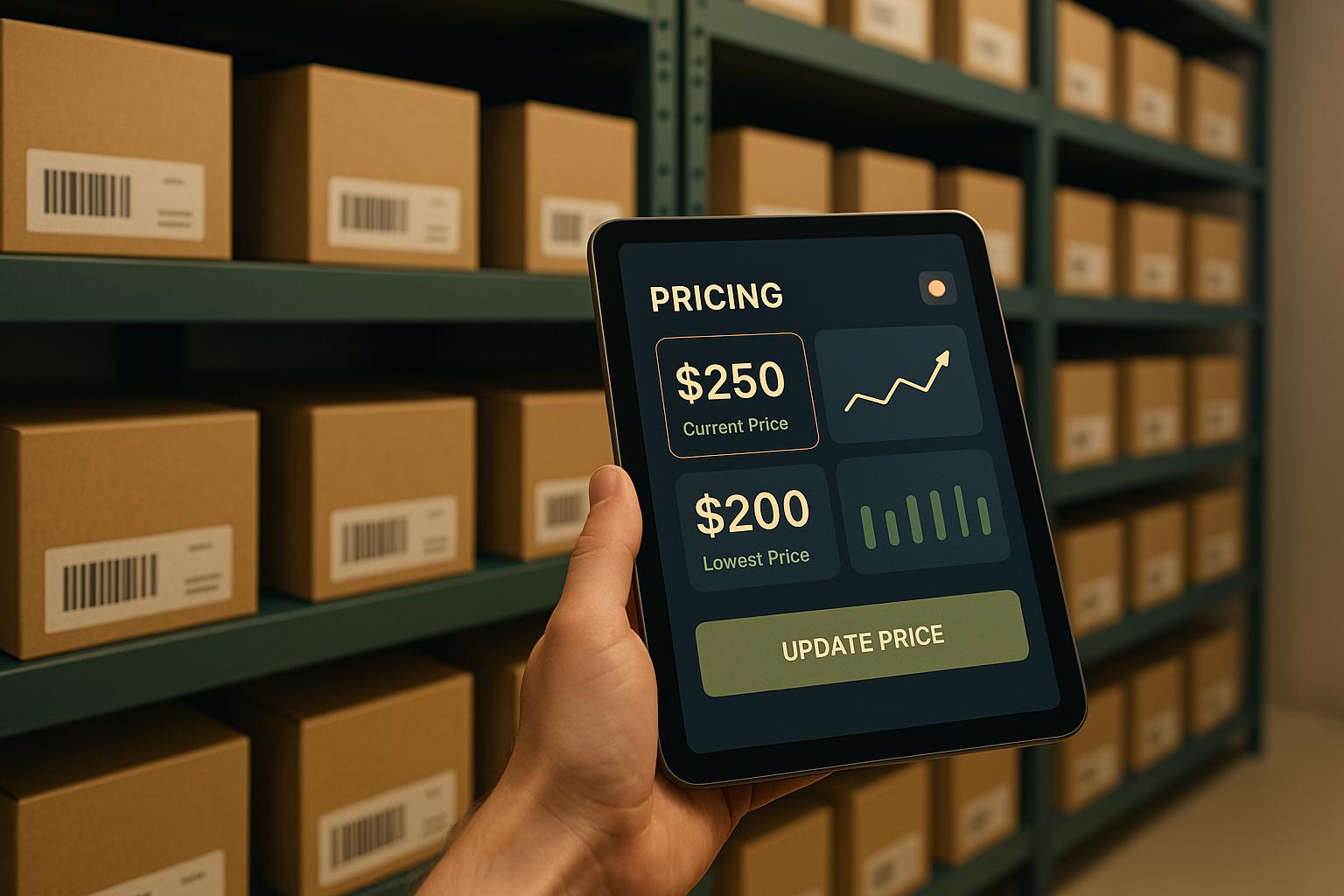
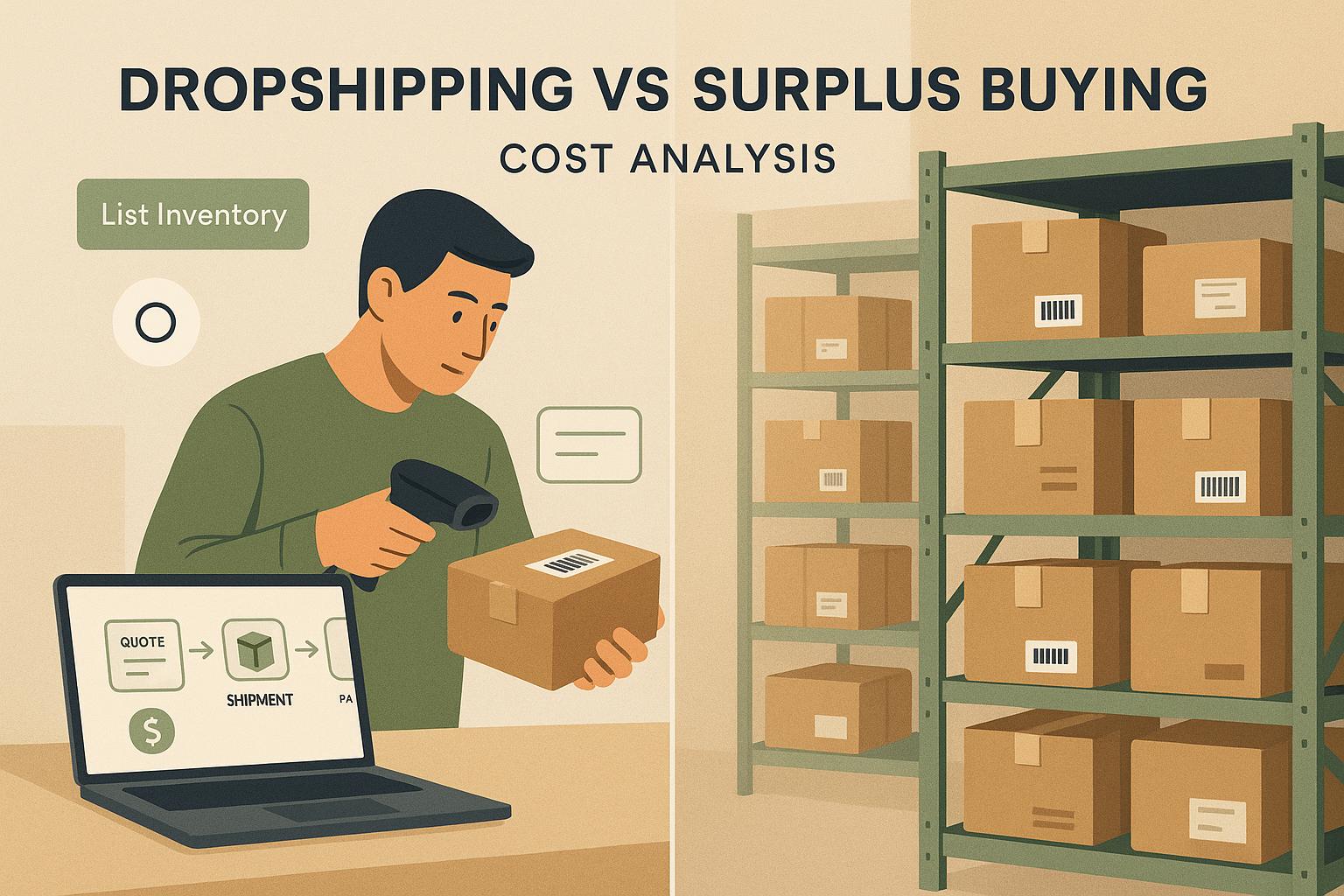
Excess inventory is a growing problem, costing businesses billions and harming the planet. Here's how you can tackle it responsibly:
- Identify and Categorize Stock: Break down surplus items by condition (new, lightly used, damaged) to decide the best course of action.
- Prevent Overstock: Use demand forecasting tools and Just-in-Time inventory practices to avoid future surplus.
- Resale or Donation: Sell excess items through resale programs or donate to nonprofits for tax benefits and goodwill.
- Recycle Responsibly: Partner with certified recyclers to recover materials and reduce waste.
- Streamline Shipping: Use eco-friendly packaging and consolidate shipments to cut costs and emissions.
- Track Progress: Monitor disposal efforts, recovery rates, and compliance to improve efficiency and align with regulations.
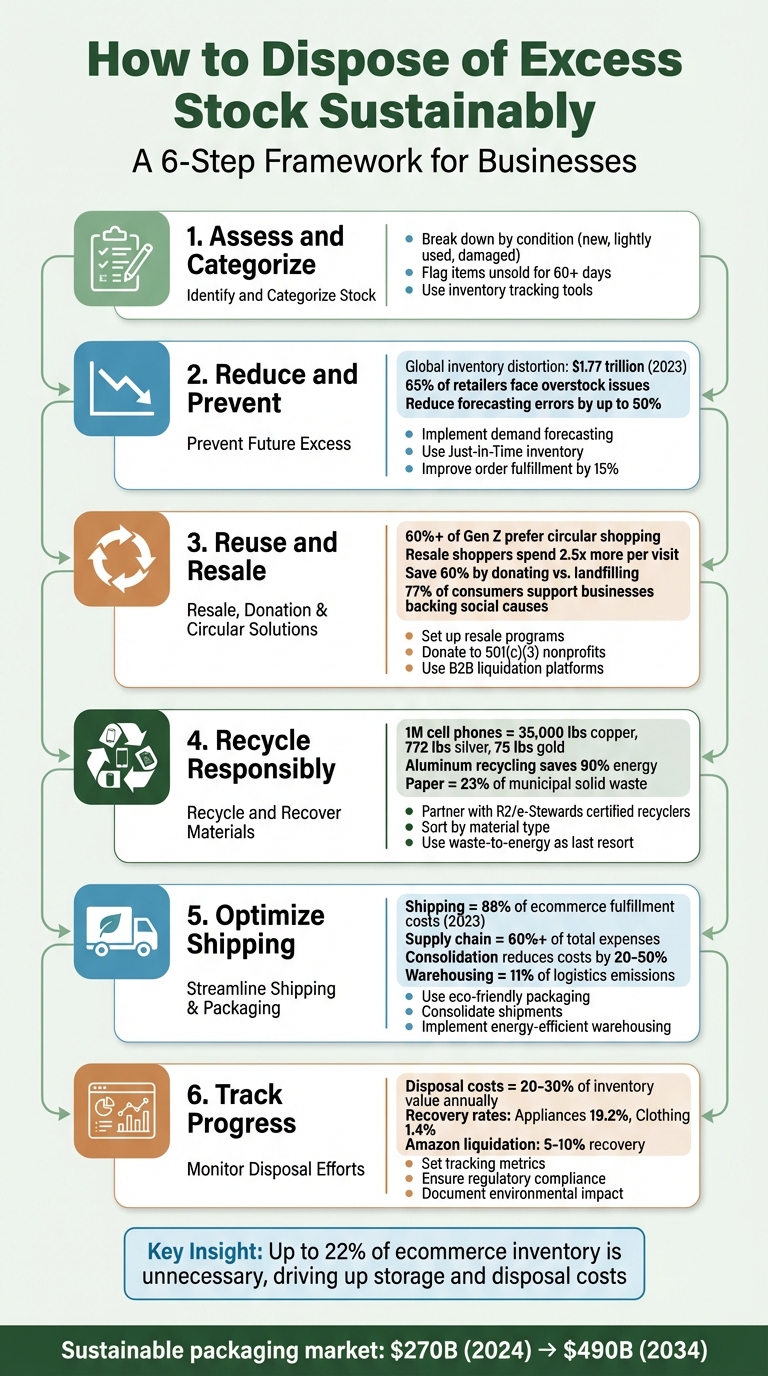
6-Step Process for Sustainable Excess Inventory Disposal
The RIDICULOUS WAY LUXURY BRANDS GET RID of their UNSOLD STOCK & what will CHANGE IN 2025
sbb-itb-bc600a0
Step 1: Assess and Categorize Your Excess Inventory
Before diving into disposal methods, it's essential to pinpoint your surplus stock. Excess inventory includes unsold items that exceed forecasted demand. This could range from finished products sitting in your warehouse to raw materials and supplies that are no longer needed for production. Breaking down this inventory into specific categories helps you create tailored strategies for managing it effectively.
Identifying Excess Stock
Start by identifying slow-moving or unsellable items in your inventory. As Sortly explains, "You'll know when inventory becomes excess inventory when it approaches the end of its product lifecycle, and your business is unable to sell the item as-is". Regularly compare actual sales data with demand forecasts to spot consistent surpluses. Products that don’t sell through normal channels over time are likely excess. Tools like ForthClear can simplify this process by flagging items that remain unsold for more than 60 days.
Categorizing Inventory by Condition and Value
Once you've identified excess stock, sort it based on its condition, age, and resale potential. Create clear groups such as:
- New and unopened items
- Lightly used returns
- Products with damaged packaging
- Defective goods
This categorization helps you decide the best course of action for each group. For instance, high-value items with strong resale potential might be reintroduced to the market, while less valuable or damaged goods could be recycled or donated. Taking the time to assess your inventory this way not only simplifies the disposal process but also minimizes waste and environmental impact.
Using Tools for Inventory Tracking
Modern inventory tracking tools can make this process more efficient. These systems monitor slow-moving stock and provide alerts when items near the end of their sellable lifespan. Additionally, liquidation calculators can help you evaluate the financial implications of clearing out surplus inventory. By analyzing factors like original costs, potential revenue from discounts, and storage expenses, you can determine whether liquidation is a better option than continued storage. These tools ensure you make data-driven decisions while managing excess stock.
Step 2: Reduce and Prevent Future Excess
Cutting down on surplus inventory starts with refining how you forecast and manage operations. In 2023, global inventory distortion - caused by overstock and stockouts - hit a staggering $1.77 trillion in costs. Around 65% of retailers face these challenges due to poor inventory management practices. By improving forecasting and streamlining operations, you can significantly lower these costs and free up warehouse space for what truly matters. These steps also set the stage for long-term solutions to avoid future inventory surplus.
Implementing Demand Forecasting
Using data to predict customer demand can make a world of difference. By analyzing past sales, market trends, and seasonal patterns, businesses can reduce forecasting errors by up to 50%. This means fewer instances of overstock cluttering your warehouse.
The secret to success lies in picking the right forecasting model for your products. For stable demand, a Simple Moving Average works well. For products with fluctuating demand, Exponential Smoothing is a better fit. As Steve Sensing, President of Supply Chain Solutions at Ryder System, Inc., puts it:
"Accurate demand forecasting plays a crucial role in right-sizing inventory levels, which is why companies are utilizing AI-based demand forecasting in the warehouse."
To make forecasting even stronger, integrate insights from sales, finance, and operations. Aligning promotions and budgets with order planning ensures everything stays in sync.
Optimizing Inventory Management Practices
Forecasting is just one part of the equation - effective inventory management is the other. A Just-in-Time (JIT) approach, where goods arrive only as they're needed, is a great strategy for minimizing on-hand inventory. However, this method works best when suppliers are dependable and demand patterns are steady. If your supply chain is less predictable, maintaining safety stock can help handle unexpected demand surges without leading to chronic overstock.
Leverage technology to keep things running smoothly. For example, set up automated alerts in your Warehouse Management System to trigger reorders at the right time. These alerts eliminate the need for manual guesswork, which often leads to over-ordering "just in case." When inventory forecasting is synchronized with your supply chain, you can improve order fulfillment rates by up to 15%, ensuring you have the products customers need without piling up excess stock.
Keeping your data clean is another critical step. Regularly normalize data and identify outliers so that one-time sales spikes don’t throw off future predictions. Compare actual sales to forecasts on a monthly basis to spot gaps and fine-tune your assumptions. This keeps your inventory aligned with real market demand and reduces the risk of surplus stock. Plus, these practices can align with broader goals, like reducing waste and improving efficiency.
Step 3: Reuse, Resale, and Circular Economy Solutions
Once you've got a handle on inventory management, the next step is turning surplus stock into revenue. Instead of letting excess items collect dust or clog up landfills, consider keeping them in circulation. This approach not only cuts down on waste but also resonates with today's consumers. In fact, over 60% of Gen Z shoppers prefer brands that offer circular shopping options. It’s a win-win: better for the planet and your bottom line.
Setting Up Resale Programs
Launching a resale program for surplus inventory is a smart way to tap into the growing demand for secondhand goods. Resale shoppers, on average, spend 2.5 times more per visit when brands offer both new and pre-owned options. Whether it’s a take-back program, peer-to-peer marketplace, or outsourcing through Resale as a Service, there’s a model to suit your business.
Technology plays a big role in making resale seamless. AI-powered pricing tools can help you set competitive prices for pre-owned items, while integrated inventory systems let you manage both new and secondhand stock effortlessly. Branding matters too - your resale platform should feel like a natural extension of your business, not a discount corner. Track key metrics, such as how quickly pre-owned items sell and how many resale customers eventually buy full-price products. This "graduation" effect often justifies the upfront investment in resale infrastructure.
Donating to Charities or Nonprofits
Donating surplus inventory to nonprofits is another effective way to clear space while benefiting from tax deductions and boosting your brand image. On average, companies save 60% by donating inventory instead of opting for landfilling or liquidation. To ensure compliance, verify that the recipient is a qualified 501(c)(3) organization using the IRS Tax Exempt Organization Search tool. For donations valued at $250 or more, make sure to get written acknowledgment from the charity.
C-corporations can claim enhanced deductions - combining the cost basis with half the appreciation, up to twice the cost basis - when donating to organizations that assist the ill, needy, or infants. Other business structures are limited to deducting just the cost basis. Adjust your Cost of Goods Sold to exclude donated items and avoid double-dipping on expenses. If non-cash contributions exceed $500 in a year, file Form 8283 with your tax return. For donations over $5,000, you’ll also need a qualified appraisal completed within 60 days of the donation.
Platforms like LiquiDonate and The Charity Hub simplify the donation process by connecting your inventory with vetted nonprofits. For example, The Charity Hub, founded in 2021 by Dave Rolleston, buys surplus inventory and donates 50% of net profits to the supplier’s chosen charity. By March 2023, the initiative had donated $400,000 to various causes, including $100,000 raised in just its first 65 days. Beyond the financial perks, there’s a reputational boost: 77% of consumers are more likely to support businesses that back social causes. Plus, prioritizing these efforts can increase customer loyalty by 20%. If resale or donation isn’t an option, liquidation platforms provide a practical fallback.
Using B2B Liquidation Platforms
B2B liquidation platforms are an efficient way to offload surplus inventory in bulk. These platforms connect sellers with buyers, handling everything from product listings to secure payments, so you can focus on running your business. For example, ForthClear’s Shopify App identifies dead stock (items with no sales for 60+ days) and suggests them for liquidation. You can list products quickly, set bulk pricing tiers, and negotiate with verified buyers using built-in messaging.
Security is critical in bulk transactions, and ForthClear ensures this by using Stripe escrow payments. Funds are only released once the buyer confirms delivery - or automatically after 14 days if no disputes arise. The platform charges a flat 5% fee per sale, with no upfront costs or subscriptions. For businesses without Shopify, products can be uploaded manually or via CSV files, with features like auto-image search simplifying the process. Cross-border tools, including tariff estimates, make it easier to expand your reach and sell internationally.
Step 4: Recycle and Recover Materials Responsibly
When surplus stock can't be repurposed, the next step is to recycle it responsibly. Start by identifying which materials can be recycled and connect with the right partners to handle them. Begin by sorting unsellable items into categories like paper and cardboard, plastics (labeled with resin codes 1–7), glass, metals, electronics, and textiles. For instance, when recycling plastics, ensure items are "spatula-clean" - heavily soiled materials can't be recycled, but minor grease stains are acceptable.
Recycling Programs for Common Materials
Recycling even small items can make a big impact. For example, recycling one million cell phones can recover 35,000 pounds of copper, 772 pounds of silver, 75 pounds of gold, and 33 pounds of palladium. Many major retailers, including Best Buy, Staples, and Amazon, offer free drop-off or mail-in recycling programs for electronics. Through the Dell Reconnect partnership with Goodwill Industries, you can drop off used electronics of any brand at over 2,000 Goodwill locations in North America. Dell Technologies then ensures non-functional items are responsibly recycled.
Before recycling electronics, remember to permanently delete all data or use a service that provides a Certificate of Data Destruction. For batteries, secure the terminals with clear tape or place them in separate plastic bags to avoid short circuits during transport. Programs like Call2Recycle partner with retailers such as The Home Depot and Lowe's to provide convenient collection points for rechargeable batteries. Recycling aluminum, for example, saves up to 90% of the energy required to process raw ore, while paper products account for about 23% of municipal solid waste annually.
Waste-to-Energy Solutions
If traditional recycling isn't an option, waste-to-energy facilities can turn unrecyclable stock into biofuel or electricity. This method allows you to recover some value while minimizing environmental harm. However, this should only be a last resort - after you've explored resale, donation, and standard recycling methods. Collaborating with certified recyclers ensures that even challenging waste streams are processed responsibly.
Partnering with Recycling Organizations
Teaming up with certified recycling organizations ensures materials are handled properly. For electronics, look for facilities certified with R2 (Responsible Recycling) or e-Stewards certifications, which uphold strict environmental and data security standards. The EPA also provides directories of certified recyclers to help you find trustworthy partners.
"EPA encourages all electronics recyclers to become certified by demonstrating to an accredited, independent third-party auditor that they meet specific standards to safely recycle and manage electronics." - US EPA
For materials that are hard to recycle, such as mixed plastics or obsolete inventory, companies like TerraCycle offer solutions. TerraCycle specializes in managing waste streams that municipal programs won't accept. Their prepaid "Zero Waste Boxes" cover storage, shipping, and recycling in one package. For textiles that can't be resold, organizations like Debrand work with brands to recycle unsellable items. For example, lululemon partners with Debrand to process items that don't meet resale quality standards as part of their commitment to creating 100% sustainable products by 2030. Some partners even provide monthly impact reports, which can help track progress toward ESG goals and share results with stakeholders.
Step 5: Optimize Shipping and Packaging for Disposal
After focusing on recycling and recovery, the next step is to refine your shipping and packaging practices. Why? Because these elements play a huge role in your carbon footprint and overall supply chain costs, which can account for over 60% of expenses. In fact, shipping alone made up a staggering 88% of ecommerce fulfillment costs in the US in 2023. By streamlining how you package and transport surplus inventory to liquidators, charities, or recycling facilities, you can significantly cut costs while reducing environmental harm.
Using Eco-Friendly Packaging
When disposing of surplus inventory, the packaging you choose matters. Opt for materials that are easy to recycle or compost, such as corrugated cardboard, paper mailers, or aluminum. The market for sustainable packaging is booming - it was valued at $270 billion in 2024 and is expected to hit $490 billion by 2034.
To avoid waste, don’t overdo it with nested packaging. Use right-sized packaging to eliminate unnecessary material and weight. For items like textiles or bedding, vacuum-sealing can shrink package volume, letting you use smaller shipping containers. Swap out standard plastic packing tape for water-activated reinforced paper tape, which can be recycled alongside cardboard.
If you're managing larger-scale disposal for B2B purposes, reusable shipping tools - like pallets, bins, and containers - can be a game-changer. While eco-friendly options might seem pricier upfront, they often save money in the long run by reducing package weight and warehouse space needs. Plus, some suppliers offer low Minimum Order Quantities (MOQs), like 100-unit mailer packs, making it easier for smaller businesses to make the switch.
"Reducing the weight of your packaging is a win-win: it minimizes both waste and cost!" - ShipBob
Once your packaging is sorted, the next step is consolidating shipments to further cut costs and emissions.
Consolidating Shipments
Shipping individual parcels to multiple destinations is inefficient. Instead, consolidate your inventory into fewer, larger shipments. This strategy maximizes the space and weight capacity of trucks or containers. By doing so, you reduce the number of partially loaded vehicles on the road, which means less fuel burned and fewer carbon emissions. Freight consolidation can lower transportation costs by 20–50%.
Consolidated shipments also limit handling to just 1–2 touchpoints, cutting down on product damage and energy use from repeated loading and unloading. To make this work, coordinate disposal schedules across teams or suppliers to create high-volume loads that are easier to consolidate. Partner with third-party logistics providers offering consolidation services and use warehouse management systems to fine-tune load planning.
"The freight consolidation process is typically more sustainable than other shipping methods. It maximizes the space used and decreases shipments of partially loaded trucks or containers. The result? Fewer trucks on the road and reduced carbon emissions." - Shopify Staff
Leveraging Energy-Efficient Warehousing
While preparing surplus stock for disposal, don’t overlook your warehouse operations. Warehousing accounts for 11% of all greenhouse gas emissions in the logistics sector. By making energy-efficient upgrades, you could cut energy costs by up to 20%.
Start with lighting - replace traditional bulbs with LED systems equipped with motion sensors to ensure lights are only on when needed. Upgrade to smart thermostats and energy-efficient HVAC systems to better control the climate. Review your warehouse layout to minimize unnecessary movement of goods and designate zones with tailored lighting and heating based on activity levels. Install Variable Frequency Drives (VFDs) on conveyor motors to adjust speed based on demand, reducing wasted energy.
Encourage staff to report issues like equipment leaks to keep everything running smoothly. Digitize inventory tracking with warehouse management systems to eliminate the need for paper logs during disposal. These steps not only reduce environmental impact but also appeal to today’s consumers - 46% of them prefer businesses that prioritize environmental responsibility.
Step 6: Track and Measure Disposal Efforts
Once your shipping and packaging processes are running smoothly, it’s time to shift your attention to tracking how effectively you’re managing excess inventory disposal. This step is all about measuring the value you recover and keeping tabs on disposal costs, which can make up 20–30% of your total inventory value annually.
Setting Up Inventory Tracking Metrics
Start by monitoring recovery rates, as these vary widely by product category. For instance, recovery rates for appliances average 19.2%, while clothing hovers around just 1.4%. If you're liquidating through platforms like Amazon, expect even lower recovery rates - typically between 5% and 10%. It’s also important to track the full spectrum of disposal costs, including logistics, shipping, and labor.
To dig deeper, analyze disposal volume by channel - whether it’s resale, donation, or recycling. This helps pinpoint which product categories frequently end up as excess stock. Tools like Parabola can simplify this process by syncing data across platforms, offering real-time insights into inventory levels and disposal rates.
Once surplus inventory is cleared, focus on recovery rates and overall disposal costs. Historical data can reveal hidden expenses, helping you plan better. For donations, consider the tax deduction value compared to liquidation proceeds. Donations often turn out to be the smarter choice financially, with companies saving an average of 60% in costs when donating inventory versus landfilling or liquidating.
This kind of tracking not only helps you cut costs but also lays the groundwork for meeting regulatory requirements.
Ensuring Compliance with Regulations
Handling electronics or hazardous materials? You’ll need to follow strict chain-of-custody protocols to ensure proper refurbishment or recycling. Items must be labeled and packaged according to specific guidelines to guarantee safe transport and eco-friendly disposal. Skipping these steps could lead to hefty fines or even the loss of selling privileges on platforms like Amazon.
For tax compliance, keep detailed records. This includes item descriptions, condition reports, and receipts from organizations receiving donations. If your donated inventory is valued at over $5,000, you’ll also need a qualified appraisal to comply with IRS guidelines. The IRS defines fair market value (FMV) as "the price that property would sell for on the open market", so documenting the exact condition of items - whether new, returned, or slightly damaged - is crucial.
Proper documentation not only keeps you compliant but also supports continuous improvement in your disposal efforts.
Documenting Progress and Improvements
To reinforce the environmental and financial benefits of your disposal strategies, make documentation a priority. Centralize records to simplify tax compliance and ESG (Environmental, Social, and Governance) reporting. Align your finance, operations, and sustainability teams on valuation methods and metrics to avoid audit risks. Additionally, track environmental impact metrics, like CO2 emissions reduced by donating goods locally instead of sending them back to central warehouses. These metrics can be used in sustainability reports to showcase your progress to stakeholders.
Automating these processes can save time and improve accuracy. Specialized software can match excess inventory with vetted nonprofits, automatically generate donation receipts, and create impact reports. Regular audits are also essential, helping you identify slow-moving stock early so you can act fast - whether that means liquidation or donation - before items become a disposal headache.
As Charles Cushing, Founder of StartOps, wisely said:
"There's more than one bottom line".
Conclusion: Key Takeaways for Sustainable Inventory Disposal
Balancing Environmental Goals with Business Needs
Sustainable inventory disposal not only benefits the planet but also helps businesses save money. Did you know that up to 22% of ecommerce inventory is unnecessary? This surplus drives up storage costs due to increased energy usage and creates challenges when it comes to disposal. By following the six steps outlined in this guide - like assessing stock levels and tracking disposal metrics - you can streamline operations, cut inefficiencies, and align with customer expectations for greener practices.
The financial perks are undeniable. Cutting down on excess inventory reduces disposal fees, lowers energy bills, and frees up valuable warehouse space. Better inventory turnover means less outdated stock and improved cash flow. Plus, resale programs and donations can open up new revenue opportunities or provide tax advantages, often outperforming traditional liquidation methods. Additionally, sustainable approaches can strengthen supply chains through local sourcing and even spark innovation by creating new products from reclaimed materials.
The secret lies in the reduce-reuse-recycle-recover framework. Start by improving demand forecasting to avoid overstocking. When surplus happens, focus on resale or donation before turning to recycling or waste-to-energy options. This strategy not only reduces your environmental footprint but also maximizes the value you recover from surplus goods.
These practical steps highlight how sustainability can be a win-win for both the environment and your bottom line.
Next Steps for Ecommerce Brands
Ready to take action? Start with an inventory audit to sort items by condition and value, laying the groundwork for a supply chain that's both efficient and eco-conscious. Invest in forecasting tools to avoid future overstock, and set clear success metrics, like improved inventory turnover and lower waste percentages.
If you're looking for a partner in sustainable disposal, ForthClear simplifies the process. Their platform lets you list surplus inventory across categories like electronics, apparel, and home goods, connecting you with verified suppliers through secure escrow payments and real-time communication. Bulk pricing and order tracking features make it easy to recover value while supporting circular economy goals. By choosing resale over landfill, you're not just clearing space - you’re actively contributing to a commerce ecosystem that reduces waste on a larger scale.
FAQs
How do I choose between resale, donation, or recycling?
Choosing what to do with your inventory - whether to resell, donate, or recycle - comes down to its condition and your priorities. Resale makes sense for items in good shape that could still turn a profit. Donation is perfect for functional goods that might not sell but can benefit others and keep waste out of landfills. Recycling is the go-to option for damaged or unusable items, ensuring materials get repurposed instead of discarded.
What records are needed for tax-deductible inventory donations?
To deduct donated inventory on your taxes, make sure to maintain thorough documentation. This includes the fair market value (FMV) of the inventory at the time of donation, a receipt or acknowledgment from the qualified charity, and appraisal reports for items of higher value. These records are essential for meeting IRS requirements and backing up your deduction claim.
How can I track the ROI and impact of excess stock disposal?
To gauge the return on investment (ROI) and overall impact, focus on tracking financial recovery, environmental outcomes, and operational efficiency. Key metrics to consider include inventory turnover, days sales of inventory (DSI), and the recovered value from sales channels. Additionally, keep an eye on reductions in storage costs, waste, and your carbon footprint to evaluate environmental progress. Consistent monitoring not only helps refine surplus management strategies but also provides a clear picture of both financial gains and environmental improvements.