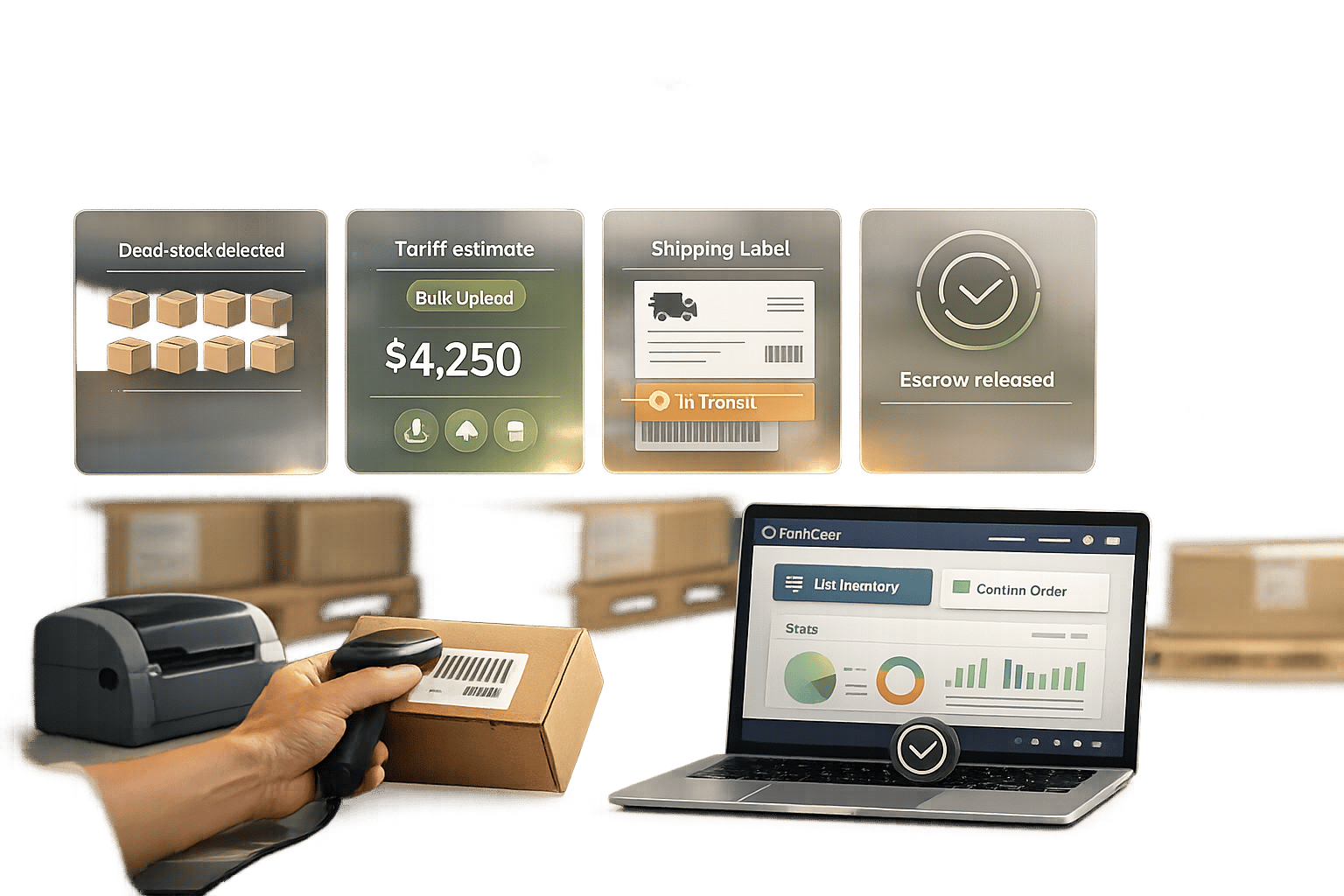
Excess inventory costs businesses $163 billion annually, with the fashion industry alone contributing $50 billion. Traditional methods like discounting, donations, or disposal come with financial losses, operational inefficiencies, and environmental harm. Peer-to-peer (P2P) inventory sharing offers a direct solution by connecting businesses with surplus stock to those in need, cutting out middlemen, and recovering value faster.
Key Takeaways:
-
Problems with Current Methods:
- Discounting: Erodes profit margins and ties up resources.
- Donations: Delays cash flow and storage costs persist.
- Disposal: Adds fees, wastes resources, and damages brand reputation.
-
Why P2P Sharing Works:
- Direct business-to-business transactions reduce costs and speed up sales.
- Platforms like ForthClear use tools like automated inventory detection, escrow payments, and bulk management features.
- Surplus inventory is sold faster, with higher recovery rates (60-80% of original value).
-
Real Results:
- DHL Supply Chain’s network diverted 200 million pounds of goods from landfills in 2024.
- Secondary markets reduce shipping emissions and waste, while cutting processing costs by 10-50%.
P2P sharing not only helps businesses recover revenue but also supports waste reduction efforts. Platforms like ForthClear make it easy to list and sell surplus stock, offering secure transactions and global reach with minimal fees. This approach transforms surplus inventory into opportunity while avoiding the pitfalls of traditional methods.
Peer-to-Peer Sharing Explained
Problems with Standard Surplus Inventory Methods
When businesses deal with surplus inventory, they often resort to discounting, donations, or outright disposal. While these methods may seem practical at first glance, they come with hefty financial, operational, and environmental costs. Let’s break down the challenges tied to discounting, donations, and disposal.
Financial Setbacks from Discounting and Donations
Discounting surplus inventory might seem like a quick fix, but it eats away at profit margins and ties up capital. Over time, products lose their value while ongoing holding costs pile up.
Consider this: the average company uses 11% to 25% of its warehouse space for obsolete and excess inventory. In 2022, U.S. retailer inventories saw a 12% increase, highlighting just how much capital gets stuck in surplus instead of being reinvested into growth opportunities.
"The rising cost of labor in stores means price changes and markdowns are squeezing margins." - McKinsey & Company
Managing discounts manually - using spreadsheets, emails, or phone calls - is not only tedious but prone to errors. Relying on a small number of liquidators or partners adds another layer of risk. It limits recovery rates and can harm a brand’s reputation if discounted goods end up in unauthorized markets.
Donations, while offering tax benefits, don’t provide immediate cash flow. The process is slow, often handled on a quarterly or annual basis. Meanwhile, surplus inventory continues to take up space and rack up storage costs until nonprofit partners can accept it. Even then, not all nonprofits have the capacity to take on certain goods, leaving businesses stuck with unsold inventory. These inefficiencies highlight the need for a smarter, more streamlined approach to redistributing surplus.
Environmental Damage from Disposal
Disposal doesn’t just drain financial resources - it’s also a major environmental concern. Landfilling surplus inventory provides no value recovery and comes with high fees for disposal and destruction services. In fact, returned inventory alone contributes roughly 5.8 billion pounds of waste to landfills every year.
The environmental toll doesn’t stop there. Disposal increases landfill volumes and adds to carbon emissions from production, transportation, and decomposition. This “take-make-waste” approach also accelerates biodiversity loss and habitat destruction. Governments are stepping in with stricter regulations, such as Extended Producer Responsibility laws and landfill taxes, to curb these practices.
"Reverse logistics is what closes the loop, making it circular." - Corey Dehmey, CEO, Sustainable Electronics Recycling International
Destroying usable goods not only wastes resources but can also backfire on a company’s image. Public backlash over discarded goods can erode consumer trust and harm brand equity. With ESG (Environmental, Social, and Governance) reporting becoming mandatory, businesses must now disclose data on waste diversion and recycling rates. Transparency is no longer optional - it’s essential for maintaining trust and compliance.
How Peer-to-Peer Sharing Cuts Inventory Waste
Peer-to-peer (P2P) sharing is changing the way businesses handle surplus inventory. Instead of relying on liquidators, donation centers, or disposal services, companies can now connect directly with others in need of the exact items they have in excess. This approach eliminates middlemen, speeding up transactions and increasing recovery rates.
Direct Business-to-Business Connections
P2P platforms act as digital marketplaces where one company’s surplus becomes another’s solution. When a business lists its excess inventory, verified buyers can claim or purchase it right away - no brokers, no extra fees. This direct connection simplifies the process and keeps costs low.
The financial benefits are clear. The U.S. re-commerce industry is valued at around $188 billion, with projections showing it could exceed $275 billion by 2028. This growth highlights the strong demand for surplus goods when businesses can connect directly.
"There is significant environmental benefit to increasing the use of existing goods and reducing the demand for new goods." - Anders Fremstad, Economics Professor, Colorado State University
Platform Features That Reduce Waste
Modern P2P platforms come equipped with tools designed to make redistribution faster and more reliable. For example, automated dead stock detection integrates with e-commerce systems to identify products sitting unsold for over 60 days. This feature helps businesses act before inventory becomes obsolete.
To address trust issues in direct B2B transactions, secure escrow payments are a game-changer. Platforms like ForthClear use Stripe to hold funds until buyers confirm delivery, ensuring both parties are protected during high-volume transactions.
Other tools, like bulk management features, simplify the listing process. Businesses can upload large inventories via CSV or Excel files, and automated image searches cut down on manual work. Negotiation tools and quote systems also allow buyers to request custom quantities, while sellers can respond quickly with offers or counter-offers. For companies dealing with international transactions, tariff estimators provide clarity on cross-border costs, opening up global markets for surplus goods.
The pricing model on these platforms is designed to encourage waste reduction. For instance, ForthClear charges no listing fees and takes only a 5% commission on completed sales. This makes it financially practical for businesses to list surplus inventory early, avoiding the need for disposal later. These features not only reduce waste but also improve financial outcomes for sellers.
sbb-itb-bc600a0
Measurable Results from Peer-to-Peer Sharing
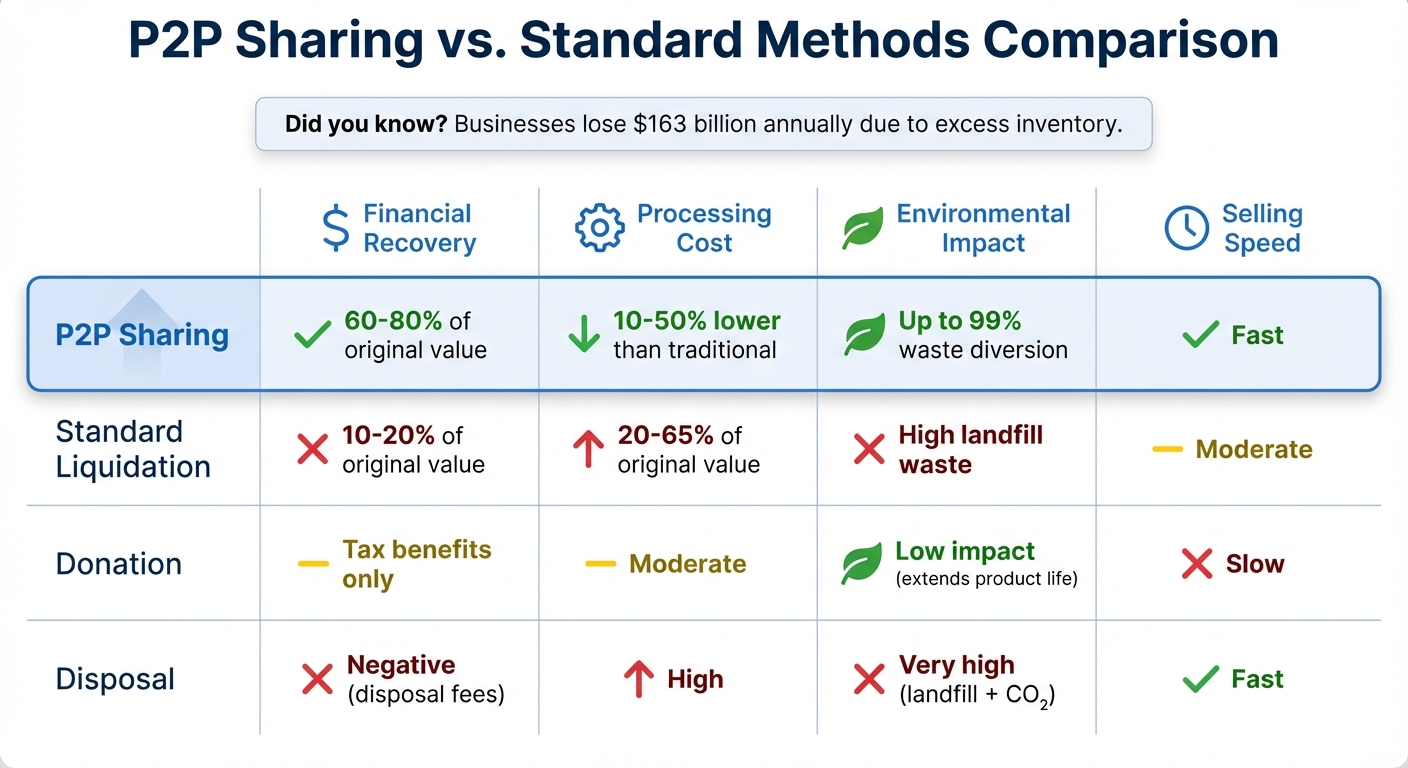
P2P Sharing vs Traditional Inventory Methods: Recovery Rates and Environmental Impact
Peer-to-peer (P2P) sharing isn't just a buzzword - it delivers real, measurable benefits. By redistributing surplus inventory to businesses that need it, these platforms help reduce waste and recover value. The results? Tangible environmental and financial gains.
Lower Landfill Waste and Carbon Emissions
One of the standout perks of P2P sharing is its ability to redirect surplus away from landfills. Take the example of DHL Supply Chain's ReTurn Network: in 2024 alone, it rerouted over 200 million pounds of returned goods from landfills, maintaining an impressive 99% diversion rate for consumer returns. This achievement was made possible through a network of 11 shared facilities and advanced automated processing systems.
Beyond waste reduction, secondary markets contribute to a lighter environmental footprint by slashing shipping costs and cutting carbon emissions. Joe Desormiers, DHL's Product Leader for Returns and Circularity in North America, highlighted this point:
"Secondary market option is attractive because it cuts out shipping costs and the possibility of returns".
And there’s more. In the U.S., heavy-duty trucks drive empty up to 35% of the time. By optimizing these "empty miles" through sharing networks, it's possible to save tens of millions of tons of CO₂ annually. These environmental wins pave the way for financial advantages, too.
Better Financial Recovery Rates
P2P platforms aren’t just about doing good for the planet - they’re also about improving the bottom line. Traditional inventory processing can eat up 20–65% of a product's value, but shared networks reduce these costs by 10–50%. Mary Cho, Director of Client Solutions at Liquidity Services, summed it up perfectly:
"The closer we can get to the end buyers, the higher the revenue recovery".
P2P Sharing vs. Standard Methods Comparison
Here’s how P2P sharing stacks up against more conventional methods:
| Method | Financial Recovery | Processing Cost | Environmental Impact | Selling Speed |
|---|---|---|---|---|
| P2P Sharing | 60-80% of original value | 10-50% lower than traditional | Up to 99% waste diversion | Fast |
| Standard Liquidation | 10-20% of original value | 20-65% of original value | High landfill waste | Moderate |
| Donation | Tax benefits only | Moderate | Low impact (extends product life) | Slow |
| Disposal | Negative (disposal fees) | High | Very high (landfill + CO₂) | Fast |
The data makes it clear: P2P sharing outperforms traditional methods in every major category. With companies losing a staggering $163 billion annually due to excess inventory, these platforms offer a practical solution for recovering value while addressing environmental concerns.
How to Start with Peer-to-Peer Sharing on ForthClear
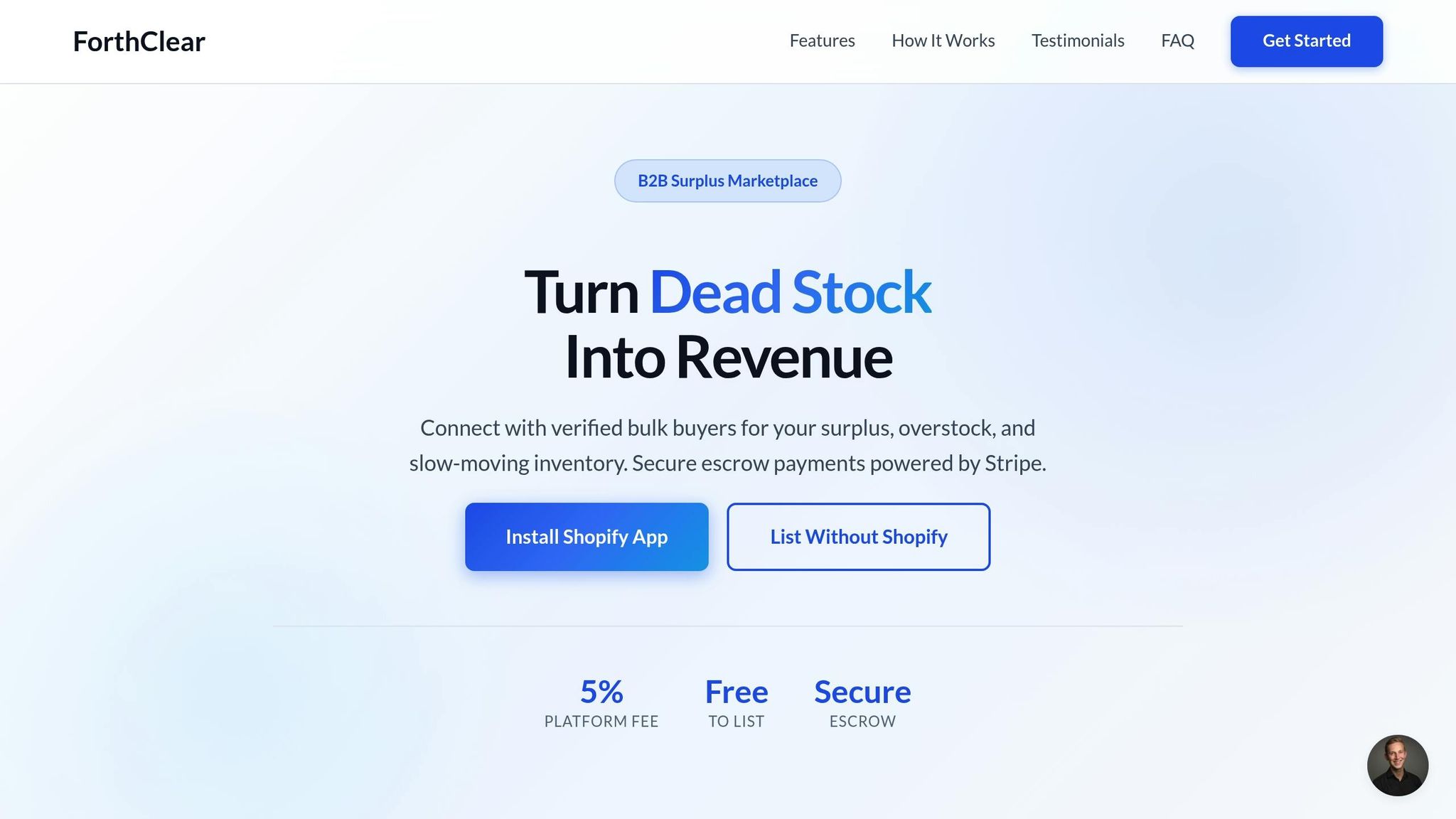
Getting started with peer-to-peer inventory sharing on ForthClear is straightforward. Whether you use Shopify or another inventory management system, the platform provides an easy way to list surplus stock and connect with verified buyers.
Setting Up ForthClear
If you're a Shopify merchant, you can install the ForthClear app directly from the Shopify App Store. This allows you to sync your inventory automatically. For businesses not using Shopify, signing up through the web dashboard is just as simple. You can upload products manually or use a CSV/Excel file for bulk uploads.
The platform's Auto-Detect tool identifies products that have been unsold for 60+ days, helping you pinpoint slow-moving inventory. For businesses with extensive stock, the bulk upload feature includes an auto-image search tool, which automatically finds product photos - saving you hours of effort.
Hylke Reitsma, Co-founder of vybey, shared:
"Easy to get started and offload some of our products that were nearing expiry date."
Once your inventory is live on ForthClear, you can tap into its integrated tools to recover value efficiently.
Using Core Features for Better Results
After listing your products, take advantage of ForthClear's features to boost sales and build trust. For example, you can set tiered bulk pricing to attract buyers looking for larger quantities, helping you clear stock faster.
All transactions are processed through a secure escrow system powered by Stripe. This holds funds until delivery is confirmed or 14 days have passed, ensuring peace of mind for both parties. Gordon Belch, Co-founder of vybey, highlighted:
"ForthClear has revolutionized how we handle excess inventory. The secure payment system and quality suppliers have made our sourcing process incredibly efficient."
The platform also includes a built-in messaging system that allows you to negotiate directly with buyers. If someone requests a specific quantity or price, you can respond quickly to close deals. There’s no cost to list your inventory, and ForthClear charges a 5% platform fee only when a sale is successfully completed.
Expanding Your Waste Reduction Efforts
ForthClear supports international sales by providing tariff estimates upfront. These estimates help you calculate duties and taxes, making it easier to price your products competitively for global buyers. While you’ll handle your own shipping logistics, having clear cost details removes much of the guesswork.
The platform accepts a wide range of surplus inventory, including overstock, returned items, end-of-line products, and slow-moving stock. Buyers don’t pay any platform fees, which allows you to offer better deals while recovering value from items that might otherwise go to waste. These features not only help you recoup costs but also contribute to reducing inventory waste in a meaningful way.
Conclusion
Peer-to-peer inventory sharing provides a practical way to handle excess inventory. Instead of letting surplus items lose value in storage or disposing of them, businesses can connect directly with verified buyers who need those products. This approach not only reduces costs - by as much as 64% compared to traditional liquidation methods - but also speeds up the process, delivering results four times faster.
With ForthClear, the process becomes even more seamless. The platform automates inventory identification, listings, and secure payments through Stripe escrow. A 5% fee is charged only when recovery is successful, and there are no fees for buyers, making surplus inventory more appealing to bulk purchasers. These features make it easier for businesses to recover revenue quickly while cutting down on waste.
Beyond the financial benefits, peer-to-peer sharing also supports environmental goals. It can halve carbon footprints by reducing shipping distances and minimizing packaging waste. As the re-commerce market is projected to reach $275 billion by 2028, businesses that embrace peer-to-peer sharing now are better positioned to meet growing sustainability demands and stay ahead of regulatory changes.
Whether you're dealing with seasonal overstock, returns, or items nearing expiration, peer-to-peer sharing transforms potential losses into recoverable revenue. With tools that simplify the process, secure transactions, and access to a network of verified buyers, this approach makes reducing waste and boosting profits more accessible than ever.
FAQs
How does peer-to-peer inventory sharing help reduce waste and protect the environment?
Peer-to-peer inventory sharing offers a smart way to cut down on waste by redistributing surplus stock that might otherwise end up in the trash. Instead of letting unused goods go to waste, this system gives them a second life, helping to curb the environmental impact of overproduction, excessive transportation, and disposal. By keeping products in use longer, businesses can adopt greener practices and shrink their environmental footprint.
This approach also reduces the demand for new manufacturing, conserving raw materials, lowering energy usage, and decreasing greenhouse gas emissions. By working together, companies can create a more efficient and eco-friendly supply chain, encouraging resourcefulness and a more responsible approach to managing inventory.
How can peer-to-peer platforms help businesses save money on surplus inventory?
Peer-to-peer platforms give businesses a practical way to sell surplus inventory directly to buyers. This approach helps companies recover some of their costs and avoid the financial hit that often comes with overstock or outdated products. Plus, it sidesteps the high expenses tied to traditional liquidation methods, making the process more efficient and cost-effective.
Beyond the financial benefits, these platforms also help reduce waste. By finding new uses for surplus goods, businesses can turn what might have been losses into revenue. At the same time, this practice supports environmentally friendly efforts by extending the lifecycle of products instead of sending them to landfills.
How does ForthClear ensure safe and secure transactions for businesses?
ForthClear places a strong emphasis on keeping transactions safe by using secure escrow payments. This approach ensures that funds are securely held until the buyer confirms the goods or services have been delivered, offering protection for both buyers and sellers.
By incorporating features such as verified suppliers and real-time communication, ForthClear builds trust and clarity into the process, making business transactions smooth and dependable.