Overstock inventory costs businesses up to 30% of its value annually in holding expenses. Clearing it quickly can recover 50-80% of your initial investment while freeing up warehouse space and unlocking cash flow. Here’s how to do it:
- Identify overstock: Use metrics like Days Sales of Inventory (DSI) and categorize inventory (e.g., deadstock, slow movers).
- Set pricing strategies: Start with bold discounts, bundle items, or use dynamic pricing to move products while preserving margins.
- Leverage B2B marketplaces: Platforms like Forthclear help sell bulk inventory efficiently with low fees and secure payments.
- Automate processes: Use tools to track inventory, flag slow movers, and simulate pricing scenarios for better decisions.
- Track results: Monitor recovery rates, sell-through rates, and ROI to evaluate success and refine future strategies.
Clearing overstock doesn’t have to mean huge losses. With the right tools and methods, you can turn stagnant inventory into cash and reinvest in products that sell.
Overstock Inventory Clearance Statistics and Recovery Rates
Unused Inventory? Here’s How to Turn It into Profit (Instead of a Problem)
How to Identify Overstock Ready for Clearance
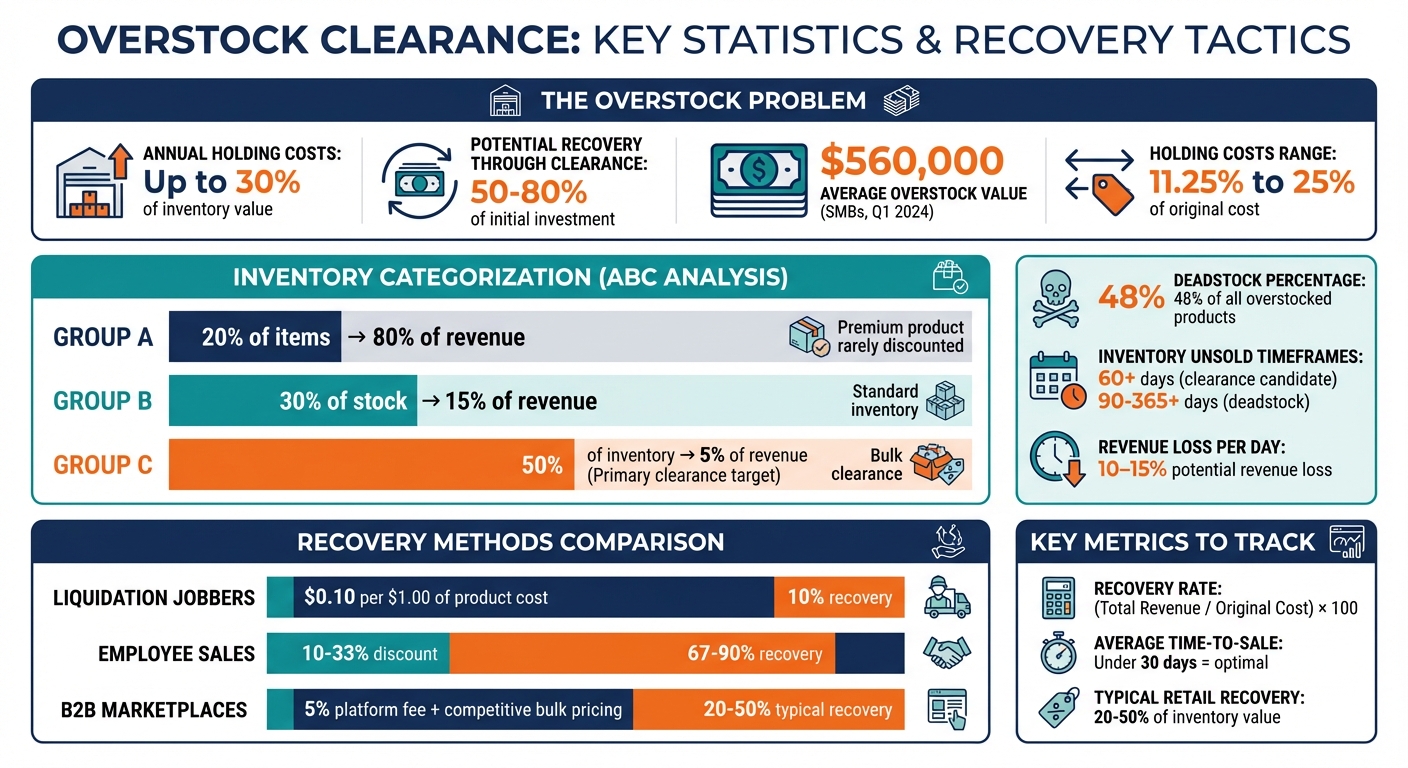
Spotting overstock starts with tracking how long items stay unsold. Many businesses consider inventory that hasn't moved in 60+ days as a candidate for clearance. Why? Because stagnant inventory signals low demand and rising holding costs. In fact, each additional day can lead to an estimated 10% to 15% loss in potential revenue.
A key metric to watch is Days Sales of Inventory (DSI). For example, if specialty items have a DSI of 145 days, compared to the typical 25 days, it's a clear sign they need to be cleared out. Another way to assess overstock is by calculating months of stock. Divide your current inventory by your average monthly sales - if you’re holding years’ worth of stock instead of weeks or months, it’s time to take action.
Deadstock, which refers to items that haven’t sold in 90, 180, or even 365+ days, makes up about 48% of all overstocked products on average. These products should be liquidated quickly. For context, in Q1 2024, small and medium-sized businesses reported an average overstock value of $560,000, with holding costs adding 11.25% to 25% on top of the inventory's original cost.
Methods for Categorizing Your Inventory
Once you've identified overstock, the next step is organizing it for clearance. ABC Analysis is a simple yet effective method. Here’s how it works:
- Group A: The top 20% of items that generate 80% of revenue. These are rarely discounted.
- Group B: Items that make up 30% of stock, contributing 15% of revenue.
- Group C: The remaining 50% of inventory, which accounts for just 5% of revenue.
Focus your clearance efforts on Group C first. These low-value, high-volume items often sit forgotten in warehouses, tying up valuable space.
Another useful approach is the "Winners, Chasers, Deadstock" framework:
- Winners: High-demand items that sell without discounts.
- Chasers: Moderate performers that might benefit from light promotions.
- Deadstock: Items that need immediate liquidation or supplier buyback negotiations.
This method helps ensure you’re not discounting products that would sell at full price anyway.
"20% to 25% of the SKUs give you 70% to 80% of the sales in most businesses." - F. Curtis Barry & Company
Lastly, monitor your Inventory Turnover Ratio - the number of times stock is sold and replaced. A decline in this ratio over several months signals a growing overstock issue. Once you’ve categorized your inventory, automated tools can simplify the process of identifying products for clearance.
Automated Tools for Detecting Dead Stock
Automation is a game-changer when it comes to managing overstock. Manual audits are time-consuming and can divert attention from revenue-generating tasks. Automated tools, on the other hand, continuously monitor inventory and flag slow-moving items.
Take Forthclear’s Shopify integration, for example. It automatically identifies products unsold for over 60 days and suggests them for liquidation with just a few clicks. These tools also calculate crucial metrics - like original cost, projected revenue, promotional expenses, and potential profit or loss - to determine whether clearance is worth pursuing.
Many systems offer "Feasibility Assessments", which highlight unrealistic weekly sales targets. If a product gets flagged with a "High Weekly Target Alert", you might need to increase your promotional budget or explore multi-channel marketing to move inventory faster.
Automation also allows you to simulate pricing scenarios, helping you avoid costly mistakes like setting prices too low or underestimating marketing spend. By flagging items nearing critical sales thresholds, these tools take the guesswork out of clearance planning. This ensures no opportunity - or inventory - slips through the cracks.
Pricing Tactics to Recover Margins
When setting clearance prices, aim to move inventory quickly while still recovering margins. Price too low, and you sacrifice profit; price too high, and holding costs - ranging from 11.25% to 25% - can eat into your bottom line.
A bold first price cut is often the most effective way to signal urgency and reduce holding costs. Small, gradual markdowns may come across as hesitant and could fail to move stock efficiently. Instead, a significant initial discount can clear inventory before costs spiral.
Another strategy is bundling slow-moving items with popular products. This approach helps maintain margins while offloading less desirable inventory. You can also implement tiered bulk discounts, such as offering 10% off for purchases of 20 units and 20% off for buying 50 or more, to encourage larger orders.
For immediate results, consider 48-hour flash sales. Automated inventory systems can trigger these campaigns when products remain unsold for 90 days, helping you offload overstock before holding costs climb further.
Finally, dynamic pricing models can help optimize discounts in real time to recover margins effectively.
Dynamic Pricing Models
Dynamic pricing adapts to factors like inventory age and demand, ensuring discounts align with the product's lifecycle. For instance, applying moderate discounts early on and increasing them over time can help clear older stock while giving newer items a chance to sell at better margins.
Tiered bulk discounts also work well within dynamic pricing. Offering progressively deeper discounts for larger orders - like 10% off at one volume threshold and even more for higher quantities - can incentivize bulk purchases, reducing per-unit holding costs.
For high-value or unique items, auction-based pricing might be worth exploring. By setting a reserve price (your minimum acceptable recovery) and allowing buyers to compete, you may achieve better returns than with traditional clearance pricing.
These strategies provide more precision when calculating margins for clearance pricing.
Calculating Margins for Clearance Pricing
Before setting clearance prices, calculate your break-even point. This includes not just the product’s original cost but also accumulated expenses like storage fees, labor, credit borrowing costs, and the opportunity cost of tied-up capital.
Compare different recovery methods to find the most effective option. Selling to liquidation jobbers, for instance, typically recovers only $0.10 per $1.00 of product cost. Employee sales, on the other hand, allow for discounts of 10% to 33% while still recovering costs and potentially generating profit. B2B marketplaces offer a middle-ground solution, with a predictable 5% platform fee and the ability to set competitive bulk prices to better preserve margins.
A helpful formula to evaluate pricing strategies is:
Clearance Price × Units Sold – (Holding Costs + Platform Fees) = Net Recovery
For example, compare a $30 clearance price that moves 200 units versus a $25 price that moves 500 units. Faster clearance often reduces holding costs, so running these scenarios can help identify the most profitable approach.
Automated simulation tools can simplify this process, allowing you to test different pricing strategies and ensure that quick stock movement maximizes net recovery.
"Holding low margin product can become costly. Additionally, many consumer products have a short life cycle and you don't want to be left with large remainder quantities by waiting for them to sell at full price".
Aggressive pricing helps free up capital, enabling you to invest in products with stronger profit potential.
Selling Overstock Through B2B Marketplaces
B2B marketplaces offer a fast and efficient way to connect with verified bulk buyers, cutting out the need for cold calls and lengthy individual negotiations. These platforms streamline the process by vetting buyers, securing payments, and providing tools to list large quantities of products in just minutes. Combined with earlier pricing and categorization strategies, they make clearing out overstock much easier.
One major advantage is payment protection. Many modern platforms use escrow systems, where funds are securely held until the buyer confirms delivery. This safeguards sellers from scams and gives buyers confidence in the transaction process. This is especially important for high-value bulk orders, as fraud risks are significant. For instance, during the early pandemic, Business Email Compromise scams involving payment and invoice fraud surged by 200% in just one month.
When choosing a platform, focus on those with PCI DSS Level 1 compliance for credit card data safety and automated Know Your Business (KYB) checks to ensure buyers are legitimate businesses, not fraudulent entities. Features like split payments can simplify transactions by automatically dividing funds into seller payouts, platform fees, and taxes, reducing errors and ensuring transparency.
For international sales, platforms with multi-currency support and local payment options are essential. The global B2B payments market hit $1.5 trillion in 2022 and is projected to surpass $3.7 trillion by 2032, highlighting the growing importance of cross-border capabilities. Built-in tariff estimators can also help sellers avoid unexpected customs issues when working with international buyers.
How to List Products Efficiently
Once you’ve ensured buyer security, the next step is creating efficient product listings. Bulk upload tools are a huge time-saver for handling large quantities of overstock. Many platforms support CSV imports, allowing you to upload hundreds of SKUs at once. Key fields to include are product name, SKU, quantity, condition, and asking price.
Some platforms offer auto-image search, which automatically retrieves product photos, saving you the hassle of uploading images manually. This is particularly helpful for sellers managing a wide range of inventory, from electronics to apparel.
If you’re using Shopify, integrations can pull inventory data directly from your store. For sellers with multiple warehouses or locations, platforms that support location-based inventory tracking are invaluable. This helps prevent overselling and allows you to specify shipping origins - critical for large orders that may require freight shipping.
Optimizing Listings to Attract Buyers
Efficient listings are only part of the equation; optimizing them is key to drawing in bulk buyers and speeding up sales. Bulk buyers look for clarity and competitive pricing, so start with detailed, descriptive titles. For example: "Samsung 55-inch 4K Smart TVs – 200 Units – New in Box" immediately communicates the product type, quantity, and condition.
In your descriptions, be transparent about why the items are being cleared (e.g., overstock, seasonal closeouts, or packaging damage). Include details like warranty status, original retail price, and whether the items are still in their original manufacturer packaging. Transparency helps build trust, making buyers more likely to engage.
Tiered bulk pricing is another effective strategy. For example, offer $50 per unit for 20–49 units, $45 for 50–99 units, and $40 for 100+ units. This encourages buyers to place larger orders, helping you clear inventory faster while still maintaining reasonable margins on larger sales.
Even in B2B transactions, high-quality photos are crucial. Include images of the products, packaging condition, and pallet configurations for bulk sales. Clear visuals help buyers assess quality and reduce back-and-forth questions, speeding up the decision-making process.
"By 2025, 80% of B2B sales interactions between suppliers and buyers are expected to occur via digital channels."
Lastly, enable direct messaging features to handle buyer inquiries quickly. Whether it’s about shipping costs, minimum order quantities, or payment terms, a fast response can mean the difference between closing a deal or losing it.
sbb-itb-bc600a0
Managing Payments and Shipping
Once you've optimized your listings and attracted buyers, the next step is ensuring smooth payment processing and reliable shipping. Mishandling these aspects can lead to fraud risks, operational inefficiencies, and strained buyer relationships - none of which you can afford when dealing with bulk transactions.
Using Escrow for Payment Protection
Escrow systems are a game-changer for securing payments in B2B overstock deals. Here's how it works: the buyer's payment is held by a trusted third party - often integrated with platforms like Stripe - until the buyer confirms delivery. This setup ensures that funds remain secure until the transaction is complete, protecting both parties involved.
Why is this so important? Overstock inventory often represents tied-up capital, limiting liquidity. Sellers, already under financial strain from unsold stock, face steep recovery challenges. Liquidation companies, for instance, may only offer recovery rates as low as 10% of the product's original cost. Using escrow to guarantee full payment becomes a vital step in recovering as much margin as possible.
Some platforms even go a step further by offering automated audit logs. These logs provide an added layer of accountability, which can be incredibly useful for tax documentation or resolving disputes down the line.
Once payments are secured, the focus shifts to shipping logistics - ensuring timely, cost-effective delivery.
Handling Shipping and International Orders
After securing payment, shipping becomes the next big hurdle. Start by calculating the true cost of delivery, which includes much more than just the shipping rate. Think about labor, facility expenses, and inventory taxes - these operational costs can significantly cut into your margins. For example, if you're clearing $50,000 worth of overstock, these additional expenses can quickly add up, impacting your bottom line.
For international orders, things get even trickier. Duties and tariffs can eat into profits if not managed carefully. Using bonded warehouses can help defer duties, keeping costs manageable. And if you're shipping to high-demand areas like Dubai, Riyadh, or Jeddah, you’ll need to account for customs clearance delays and regional storage limitations. Platforms with built-in tariff estimators can help you provide accurate quotes upfront, avoiding unpleasant surprises that might turn a profitable deal into a loss.
Don’t forget about reverse logistics - returns are a common part of B2B transactions. Pre-negotiated restocking fees with vendors, which typically run around 15%, should be factored into your overall cost calculations. If a buyer rejects a shipment, you'll need to absorb that cost, so planning ahead is crucial.
Measuring Results and Preventing Future Overstock
Keeping an eye on key metrics is essential to evaluate how well your clearance strategies are working and to avoid repeating costly mistakes. One important metric is the recovery rate, which shows the percentage of the original inventory cost recovered through clearance sales. The formula is simple: (Total Revenue from Clearance / Original Cost) × 100. For instance, clearing $10,000 worth of overstock for $4,000 gives you a 40% recovery rate. The National Retail Federation notes that most retailers recover between 20% and 50% of inventory value through liquidation and discounting strategies.
Another key metric is average time-to-sale, which measures how long it takes to sell clearance items. If you can wrap up a clearance sale in under 30 days, it’s a sign that your pricing and listing strategies are on point, and your cash flow improves significantly. Using platforms with global reach can shorten this period even further - from over 60 days to just 14–21 days. Then there’s ROI (return on investment), which you calculate as (Net Profit - Clearance Costs) / Clearance Costs × 100. For example, if you earn $5,000 in profit from $20,000 in clearance costs, that’s a 25% ROI.
Regularly tracking these metrics not only provides a clear picture of how well your clearance efforts are working but also helps shape better inventory management strategies moving forward.
Metrics to Track for Clearance Success
To truly measure clearance success, focus on these additional metrics:
- Sell-through rate: This shows how quickly you’re moving inventory and is calculated as (Units Sold / Total Overstock Units).
- Holding cost savings: This reflects how much you save on storage fees after clearing out inventory.
- Margin erosion: This compares your profit margins before and after clearance. While promotions may lower margins in the short term, the capital you recover can often be reinvested into faster-moving stock, offsetting the initial hit.
Another useful tool is exception reporting, which flags slow-moving items. By identifying these products early, you can take action before they lose even more value or become obsolete.
Strategies to Reduce Future Overstock
Analyzing your clearance results can pinpoint areas for improvement and lay the groundwork for smarter inventory planning. One effective approach is AI-powered demand forecasting, which uses sales data, seasonal trends, and market signals to predict demand. This method can cut surplus inventory by 20–50% by aligning procurement with actual needs.
You can also set up real-time safety stock alerts for items that remain unsold for more than 60 days. These alerts can prompt early clearance efforts via B2B platforms, helping you offload inventory before it becomes a liability.
Another helpful tactic is integrating bookkeeping systems to connect inventory data with financial exposure. Custom reports, such as "aged stock" or "pending returns", can highlight at-risk capital and guide decisions about markdowns or liquidation thresholds. Adjusting reorder points dynamically and tailoring liquidation strategies by product category or season ensures that your efforts balance capital recovery with margin preservation and brand reputation.
Finally, focus your resources on high-margin products rather than wasting time and effort on low-value items that offer minimal recovery potential. This targeted approach can make a big difference in both profitability and operational efficiency.
Conclusion
Clearing out overstock doesn't have to be about cutting losses or letting inventory gather dust. By combining dynamic pricing, automated tools, and strategic marketplace listings, you can create a system that not only recovers 20–50% of your inventory value but also frees up vital warehouse space. Whether you're bundling slow-moving items with bestsellers, using employee sales to recover costs, or leveraging targeted liquidation channels, the key is taking swift action to protect your margins.
To make your clearance strategy even stronger, focus on tracking metrics like recovery rate, time-to-sale, and ROI. These indicators help identify which tactics work best. Additionally, tools like AI-powered demand forecasting and real-time safety stock alerts can help you avoid future surpluses, transforming clearance from a last-minute fix to a proactive part of your inventory management.
Forthclear makes the clearance process easier by removing upfront and monthly fees. With a free-to-list model and a simple 5% platform fee on sales, you can quickly move excess inventory. Their Shopify integration automatically flags items unsold for over 60 days, while secure Stripe escrow payments ensure smooth transactions for both buyers and sellers.
Want to unlock your frozen capital? Start listing your overstock inventory on Forthclear today. No listing fees, no monthly charges - just a straightforward 5% fee when you sell. Clear out your warehouse and reinvest in inventory that generates real returns.
FAQs
What is overstock clearance?
Overstock clearance is all about selling brand-new, unused products at discounted prices. The goal? To clear out surplus inventory. This approach helps businesses recoup some of their costs while making room for more valuable storage needs.
How do I find an overstock warehouse near me?
To locate an overstock warehouse in your area, start by searching for local or regional facilities that focus on surplus inventory and liquidation. Try using phrases like “overstock warehouse near me” or “surplus inventory storage [your location]” in your preferred search engine. Additionally, check out B2B marketplaces that link sellers with nearby warehouses. For extra help, you can reach out to logistics providers or trade associations, as they often have insights into surplus storage facilities in your region.
How can I safely sell surplus inventory in bulk?
To sell surplus inventory in bulk safely, it's smart to use trusted B2B marketplaces. These platforms connect you with verified buyers, making sales quicker and improving recovery rates. Many of them also offer features like secure payment systems, tools for managing inventory, and standardized processes such as accurate valuations and detailed product listings. By sticking to these practices, you can protect your transactions, simplify the process, and reduce potential risks.