If you're a Shopify merchant, surplus inventory can drain your cash flow, increase costs, and limit growth opportunities. This guide outlines how to identify, manage, and sell surplus stock effectively. Key steps include auditing inventory, setting liquidation prices, and choosing the right sales channels like B2B marketplaces or flash sales. Tools like ForthClear and Shopify's native features can simplify the process, turning unsold goods into cash while preventing future overstock.
- Surplus inventory issues: Ties up cash, adds storage costs, and risks becoming unsellable.
- Key causes: Over-ordering, poor demand forecasting, and sudden trend shifts.
- Solutions: Audit stock, use discounts, explore B2B sales, and leverage liquidation tools.
- Tools to consider: ForthClear, Prediko, Inventory Planner, and Shopify's ABC analysis.
Act quickly - inventory sitting unsold for over 60 days can lead to significant losses.
What Is Surplus Inventory?
Surplus inventory refers to stock that exceeds what your customers currently demand. Unlike regular inventory, which is intentionally held for resale, surplus inventory sits unsold in your warehouse, adding to your daily carrying costs.
As a Shopify merchant, you might encounter several types of surplus inventory. Overstock occurs when you order or produce more units than you can sell. Slow-moving inventory includes items that linger in storage - often for 60 days or longer - without generating sales. Returns are products sent back by customers, which can pile up and eventually become obsolete if not handled properly. There’s also dead stock, which includes damaged, spoiled, or outdated items. Lastly, seasonal merchandise, like holiday decorations or summer clothing, can turn into surplus once their season ends. These issues often stem from forecasting errors or operational mistakes.
"Excess inventory is bad for business - it ties up cash flow, it takes up valuable space in-store and in storage, and stale products could negatively affect sales." - Lauren Ufford, Shopify
Several factors contribute to surplus inventory. Common causes include inaccurate demand forecasting, overproduction, sudden shifts in trends, and “discount buying,” where merchants over-purchase to secure a lower price per unit. For instance, you may stock up on a trending product, expecting high demand, only to see interest vanish when the next big thing comes along. These challenges can significantly disrupt cash flow and inventory management for Shopify merchants.
The effects on your business are substantial. Surplus inventory ties up cash flow, increases costs like storage fees, insurance, and labor, and limits your ability to invest in new, in-demand products. The longer items remain unsold, the more likely they are to become outdated, spoiled, or damaged, forcing you to take a financial loss through write-downs or write-offs. The next section will guide you through strategies to address these issues effectively.
sbb-itb-bc600a0
Why Surplus Inventory Matters for Shopify Merchants

Surplus inventory can drain your business in ways you might not immediately notice, but the impact is undeniable. When products sit unsold for 60 days or more, they stop being potential revenue and turn into dead capital - money that’s tied up and unavailable when you need it most. This lack of liquidity can block you from pursuing important opportunities, like launching a new product, ramping up seasonal marketing efforts, or restocking items that are actually selling well. Essentially, idle inventory doesn’t just sit there - it actively holds your business back by increasing costs and limiting growth.
Every day that surplus inventory lingers, storage and handling costs quietly chip away at your profits. You’re paying for warehouse space, labor to manage stagnant items, insurance, and utilities - all without any return. The stakes are even higher for merchants dealing with perishable goods or trend-sensitive items like fashion or electronics. These products lose value quickly and may eventually become unsellable, forcing you to write off the entire investment.
"Excess inventory is problematic because it ties up money that could be used for other purposes, like investing in new products or sales and marketing to expand your retail business." - Shopify
Surplus inventory doesn’t just affect your finances - it also impacts your customer experience. Regular shoppers expect to see new and exciting items when they visit your store. If they keep encountering the same outdated products, they’ll lose interest and might start shopping elsewhere. This is especially critical for physical stores, where about 90% of customers instinctively turn right upon entering. If that prime display space is filled with last season’s leftovers, you’re wasting a key opportunity to grab their attention.
Perhaps the most damaging consequence is the opportunity cost. While your competitors adapt quickly to tap into emerging trends, your budget is stuck in inventory that won’t sell. Without the flexibility to stock in-demand items, you risk falling further behind. This creates a vicious cycle: poor inventory management leads to missed opportunities, weaker sales, and even more surplus inventory. It’s a tough situation, but one that highlights the importance of staying agile with your stock.
How to Manage and Liquidate Surplus Inventory (Step-by-Step)
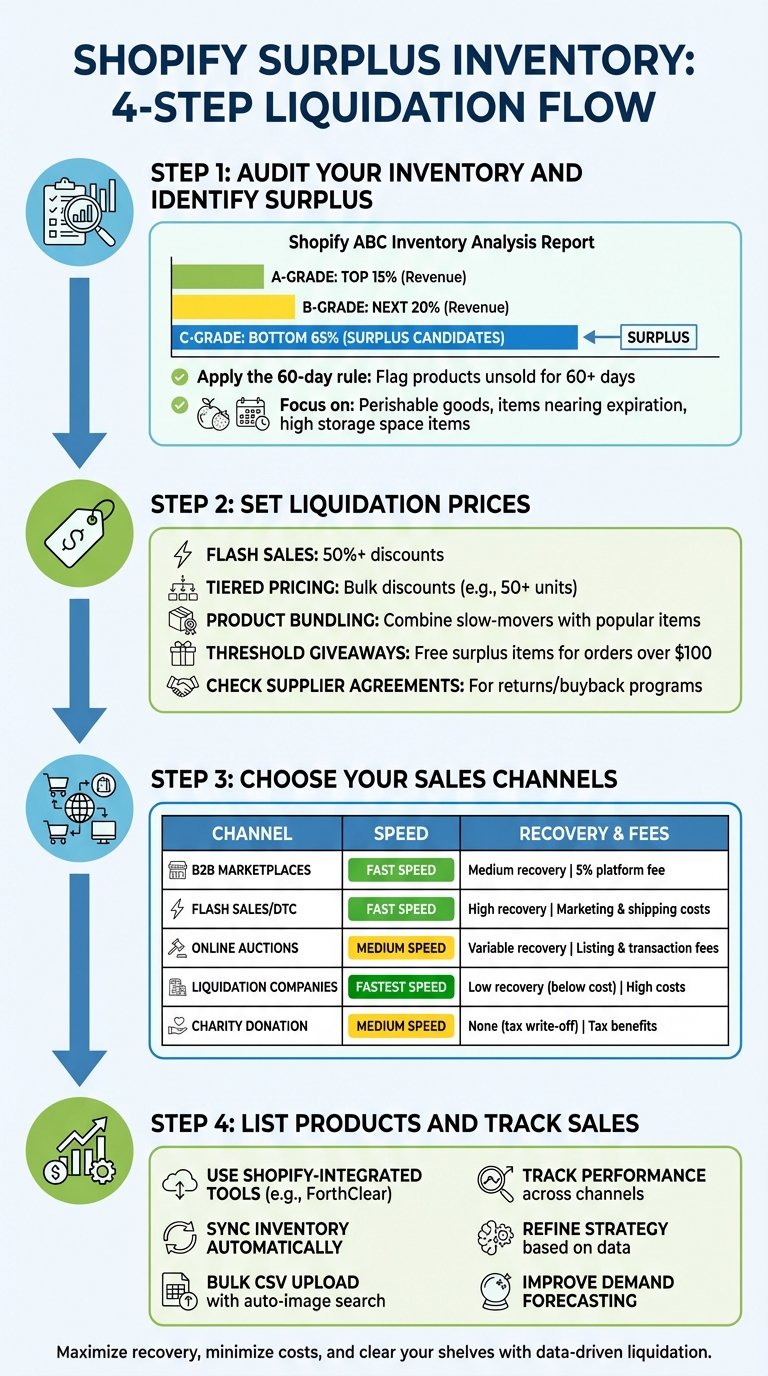
4-Step Process to Liquidate Surplus Inventory for Shopify Merchants
Turning surplus inventory into cash doesn’t have to be complicated. This guide breaks down the process into clear steps, helping you identify slow-moving items, price them effectively, and sell them through the right channels.
Step 1: Audit Your Inventory and Identify Surplus
Start by using Shopify’s ABC inventory analysis report, available in your admin dashboard. This tool divides your products into three categories: A-grade items (top 15% by revenue), B-grade items (next 20%), and C-grade items (bottom 65%). Those C-grade items are your likely surplus candidates.
To streamline this process, apply the 60-day rule: flag products that haven’t sold in over two months. Tools like the ForthClear Shopify App can make this easier by automatically identifying inactive items, saving you from manual tracking.
Focus on perishable goods, items nearing expiration, or products that take up significant storage space. These are often the most urgent to liquidate since they carry higher storage costs and risk becoming unsellable.
Step 2: Set Liquidation Prices
Once you’ve identified surplus items, the next step is to adjust their pricing to encourage quick sales. Your pricing strategy should balance the need for fast cash with the amount you aim to recover. Here are some effective approaches:
- Flash sales: Discounts of 50% or more can create urgency and move inventory quickly.
- Tiered pricing: Offer bulk discounts (e.g., reduced prices for orders of 50+ units) to attract B2B buyers.
- Product bundling: Combine slow-moving items with popular products to increase their appeal without heavy individual discounts.
- Threshold giveaways: Incentivize larger purchases by offering surplus items as free gifts for orders over a certain amount (e.g., $100).
Before slashing prices, check your supplier agreements. Some vendors may allow returns or have buyback programs, which could offer better recovery than deep discounts. Shopify POS can also help by automating discounts, whether as fixed amounts or percentages, at checkout.
Step 3: Choose Your Sales Channels
Different sales channels come with their own pros and cons, depending on how quickly you need to move inventory and the costs involved. Here’s a breakdown:
- B2B Marketplaces: Connect with bulk buyers for fast sales, typically with a 5% platform fee.
- Flash Sales/DTC Channels: Move inventory quickly with steep discounts, though marketing and shipping costs apply.
- Online Auctions: Allow competitive bidding, though final prices and fees can vary.
- Liquidation Companies: Offer the fastest cash option but often buy stock below cost.
- Charity Donations: While not generating revenue, donations can provide tax benefits and reduce storage costs.
For unknown B2B buyers, use platforms with escrow services (like Stripe-powered systems) to ensure secure transactions.
| Sales Channel | Speed of Liquidation | Recovery Rate | Fees/Costs |
|---|---|---|---|
| B2B Marketplaces | Fast | Medium (Bulk) | 5% platform fee |
| Flash Sales/DTC | Fast | High | Marketing & shipping costs |
| Online Auctions | Medium | Variable | Listing & transaction fees |
| Liquidation Companies | Fastest | Low (Below cost) | High costs |
| Charity Donation | Medium | None (Tax write-off) | Potential tax benefits |
Once you’ve picked your channels, monitor how well your products perform on each to refine your strategy.
Step 4: List Products and Track Sales
Now it’s time to list your surplus items and start selling. Shopify-integrated tools can simplify this process. For example, the ForthClear Shopify App allows you to sync inventory and list surplus items quickly. Its bulk CSV upload feature even automates image searches, saving you hours of work.
Track how your products perform across different channels. This data helps you fine-tune your approach and improve demand forecasting, reducing the chances of future surplus buildup. Automation tools can also keep your process efficient and adaptable.
"ForthClear has transformed our excess inventory handling by streamlining payments and sourcing."
- Gordon Belch, Co-founder, vybey
In 2024, vybey founders Gordon Belch and Hylke Reitsma used ForthClear to liquidate products nearing expiration. By connecting with verified bulk buyers, they turned potential losses into revenue.
"Easy to get started and offload some of our products that were nearing expiry date. Very helpful that ForthClear helps to find buyers in the process."
- Hylke Reitsma, Co-founder, vybey
For more tips on managing surplus inventory, check out these resources:
- Top Platforms For Surplus Sales And Cash Flow
- Global B2B Marketplaces Surplus Liquidation
- ForthClear Blog
Excess Inventory Auctions
Excess inventory auctions provide a flexible way to convert surplus stock into cash, complementing strategies like flash sales and direct B2B liquidations. The beauty of auctions lies in their ability to let the market decide the price, often leading to competitive bidding.
For individual items, consumer platforms like eBay work well. On the other hand, specialized B2B surplus marketplaces are ideal for connecting with buyers interested in purchasing bulk quantities.
To attract serious bidders, focus on the basics: high-quality photos and detailed descriptions. While setting a reasonable starting price is key, remember that final bids might fall below the original retail value. For bulk auctions, using tiered pricing can encourage larger orders by offering bigger discounts as quantities increase.
Streamlining the process is also critical. Features like CSV uploads and auto-image searches make it easier to list bulk items by automatically sourcing product photos. Tools integrated with Shopify can help you prioritize auctions for items sitting unsold for over 60 days.
When it comes to payment security, choose platforms that use Stripe-powered escrow services. These services hold funds until delivery is confirmed, ensuring both parties are protected. Typically, funds are released after delivery confirmation or within 14 days if no disputes arise. Some B2B marketplaces charge a 5% fee, but only when a sale is successfully completed.
Keep in mind that shipping is your responsibility. If you're working with international buyers, look for platforms that provide tariff estimates and messaging tools for negotiating custom deals. These features not only simplify logistics but also enhance your ability to manage surplus inventory effectively.
Direct B2B Overstock Sales
For Shopify merchants managing surplus inventory, selling directly to bulk buyers offers a practical way to streamline the process. By cutting out intermediaries, you take control of negotiations and connect directly with businesses like retailers, discount chains, or resellers who buy in large quantities. This approach is especially effective when dealing with significant quantities of a single SKU or product line that hasn’t moved for months. It also complements other inventory liquidation strategies you might already be using.
A key to making this method work is ensuring buyer verification. Before shipping large orders, confirm the legitimacy of the buyer. Shopify’s built-in B2B features require buyers to register as a “Company,” providing essential details like their Tax ID and company name. To add an extra layer of security, apps like Singleton can restrict public access to wholesale prices and purchasing options, making them visible only to approved buyers.
For high-value transactions, escrow payments are a smart choice. These ensure funds are securely held until delivery is confirmed. A great example of this approach in action comes from Laird Superfood. In May 2025, the company reported saving $50,000 to $60,000 annually after switching from manual phone orders to Shopify’s automated B2B portal. This change boosted their B2B sales from 25% to 75% of total revenue.
Tiered pricing is another effective tactic to encourage bulk purchases. Instead of a flat discount, offer volume-based breaks - like 10% off for 50 units, 20% off for 100 units, and 30% off for 500 or more. Pair this with a quote system to allow for custom deal negotiations. For instance, TileCloud used Shopify’s wholesale portal to offer personalized pricing and targeted promotions, leading to a 24% increase in B2B customer signups and a 34% rise in average order value year-over-year.
Shopify integrations make managing this process easier. Features like CSV uploads and tariff estimate tools let you handle listing, pricing, and order tracking right from your dashboard. Apps like Forthclear can even identify products that haven’t sold in over 60 days and connect you with verified bulk buyers. Plus, with 83% of business buyers preferring to order through a self-serve portal, this strategy fits neatly into a broader plan for managing surplus inventory effectively.
Best Tools and Software for Managing Surplus Inventory
When it comes to managing surplus inventory, having the right tools can make all the difference. Efficient software doesn't just help clear out excess stock - it can also prevent surplus issues from happening in the first place. For example, in 2025, the apparel brand Oak + Fort streamlined its inventory operations using a single system. The result? They saved 50 hours of labor per week and slashed operating costs by 47%. That’s the kind of impact smart tools can have, especially when dealing with fluctuating demand and multiple sales channels.
If you’re sitting on unsold stock, Forthclear is a standout option. This app integrates directly with Shopify, automatically identifying products that haven’t sold in 60+ days. From there, you can list them on a network of verified bulk buyers in just a few clicks. Payments are secured through Stripe-powered escrow, which holds funds until delivery is confirmed. Listing is free, with a 5% fee applied only when a sale is made.
For businesses looking to prevent surplus, Prediko uses AI to analyze sales trends and recommend stock transfers between locations. This tool is ideal for smaller businesses, starting at $49/month for those with under $500,000 in annual revenue. If you need deeper demand forecasting, Inventory Planner (owned by Sage) provides replenishment alerts based on historical data and seasonal trends. Pricing begins at $99/month.
For multi-channel sellers, Sumtracker offers real-time inventory tracking across platforms like Shopify, Etsy, and eBay. It even provides "days of inventory remaining" reports to help you time liquidation decisions effectively. Plans start at $49/month for up to 200 orders. On the enterprise side, Cin7 Core delivers full ERP functionality, including workflow automation and integration with over 700 apps, for around $349/month. Lastly, Shopify’s native tools shouldn’t be overlooked. Features like ABC analysis reports rank products by revenue contribution, helping you quickly identify low-performing items that may need discounting or removal.
Quick Comparison of Tools
| Tool | Primary Surplus Function | Automation Level | Starting Price | Global Support |
|---|---|---|---|---|
| Forthclear | B2B Liquidation Marketplace | High (Auto-detects dead stock) | Free to list; 5% fee on sale | International shipping with tariff estimates |
| Prediko | AI-driven Stock Optimization | High (Transfer recommendations) | $49/month | Multi-store tracking |
| Inventory Planner | Demand Forecasting | High (Replenishment alerts) | $99/month | Multi-currency/location support |
| Sumtracker | Multi-channel Sync | High (Real-time updates) | $49/month | Multi-location tracking |
| Cin7 Core | Enterprise Inventory/ERP | High (Workflow automation) | $349/month | Global operations support |
| Shopify Native | ABC Analysis & Flow Alerts | Moderate (Flow-based alerts) | Included with Shopify | Global (Multi-language/location) |
Surprisingly, 43% of small businesses still track inventory manually, and 34% have experienced late shipments due to inventory problems. The financial impact of poor inventory management is staggering - stockouts alone cost retailers over $1.2 trillion annually. Choosing the right software can save you from these pitfalls. Start with tools that fit your current needs but can grow with your business. And whenever possible, opt for solutions that integrate seamlessly with your Shopify setup to avoid creating data silos.
For more tips and tools, check out our resources on Top Platforms For Surplus Sales And Cash Flow, Global B2B Marketplaces Surplus Liquidation, and our Blog.
Conclusion
Surplus inventory doesn’t have to sit idle and drain resources - it can be turned into cash with the right strategy. By automating detection, choosing effective sales channels, and utilizing escrow-protected payments, businesses can reclaim tied-up capital. The key is acting quickly - don’t let inventory sit unsold for more than 60 days, as every extra day adds to carrying costs like storage, insurance, and utilities.
The most efficient strategy blends B2C methods like flash sales and product bundling with B2B liquidation for bulk removal. As outlined in this guide, combining these approaches creates a solid plan for managing surplus inventory. Shopify-integrated platforms simplify the process, from identifying slow-moving items to connecting with verified buyers. With tools like escrow protection from Stripe and a 5% fee structure applied only to completed sales, risks stay minimal.
Time is money when it comes to inventory. Unsold stock eats into margins, but by acting fast, you can free up funds for higher-demand products. Tools offering real-time inventory sync and demand forecasting ensure better long-term inventory management, reducing the chances of future overstock. This approach not only turns surplus into immediate cash but also builds a more sustainable inventory strategy.
"Easy to get started and offload some of our products that were nearing expiry date. Very helpful that ForthClear helps to find buyers in the process." - Hylke Reitsma, Co-founder, vybey