Wholesale windows allow Shopify merchants to buy window units at prices about 30% lower than retail, targeting contractors and bulk buyers who prioritize cost savings. By skipping traditional retail expenses like showrooms and sales staff, merchants can clear surplus inventory faster and improve cash flow. Surplus marketplaces, such as Forthclear, make sourcing and selling easier with low minimum orders, automated tools, and secure payments. This model helps merchants manage inventory efficiently while connecting with high-volume buyers. Here's how Shopify sellers can leverage wholesale windows to grow their business.
Why Shopify Merchants Should Consider Wholesale Windows

Wholesale windows can serve as a smart strategy for Shopify merchants, offering a way to boost revenue and speed up inventory turnover. This approach targets bulk buyers like contractors, developers, and commercial project managers who need large quantities - often dozens or even hundreds of units at once. These professional buyers prioritize cost savings over retail perks, making them a perfect audience for merchants offering competitive, contractor-level pricing. This setup not only helps clear surplus inventory but also creates opportunities for targeted bulk sales.
Wholesale pricing typically runs about 30% lower than retail prices by cutting out expenses related to showrooms, sales staff, and marketing. Advanced Window and Door Distribution sums it up well:
By dedicating ourselves to the distribution of top-quality windows solutions and doors, we can maintain lower operational costs, which results in significant financial savings for you.
By reducing these overhead costs, merchants can maintain healthy profit margins while quickly recovering cash tied up in inventory. This efficiency also helps manage surplus stock more effectively.
Clearing Surplus Inventory
Surplus inventory can drain resources by taking up storage space and tying up capital. Wholesale windows provide a straightforward solution for clearing overstock, returned items, or seasonal products that aren’t moving through regular retail channels. Offering bulk pricing for these surplus items helps move them about 30% faster than waiting for individual retail sales.
When inventory sits idle, it locks up funds that could be used for new products or marketing efforts. Selling to bulk buyers transforms dead stock into liquid cash, often within days instead of months. Some distributors even operate networks of up to 950 centers nationwide to facilitate direct-to-site delivery. This means merchants don’t have to worry about maintaining costly local storage for slow-moving items. This streamlined distribution model not only reduces logistical headaches but also speeds up cash flow.
Reaching Contractors and Bulk Buyers
Wholesale windows also open the door to targeting professional buyers with large-scale purchasing needs. Unlike individual homeowners, contractors buy for entire projects - think apartment complexes, office buildings, or housing developments. These larger orders bring predictable revenue and reduce the reliance on smaller, one-off sales.
Professional buyers value simplicity in their transactions. They usually work with their own trusted installers, so they don’t need installation services from merchants. This eliminates labor and liability costs for the seller, keeping operations lean and focused strictly on distribution. Additionally, DIY buyers - such as landlords or property managers handling renovations - are another audience for bulk sales, further expanding the customer base.
sbb-itb-bc600a0
Where to Source Wholesale Windows as a Shopify Merchant
Sourcing wholesale windows as a Shopify merchant involves finding the right balance between cost, lead times, and order flexibility. You can explore several channels, including traditional wholesale distributors, direct relationships with manufacturers, or surplus marketplaces. Each option has its pros and cons, so aligning your sourcing strategy with your inventory goals is key to improving cash flow and reaching more contractor buyers. Let’s break down these sourcing methods to see which one fits best for Shopify merchants.
Traditional wholesale distributors often cut out showroom costs and sales commissions. However, they usually come with longer lead times - up to 3–4 weeks for custom orders - and significant financial commitments. Many distributors require merchants to set up trade accounts or commit to bulk purchases, which can tie up a lot of capital.
On the other hand, surplus marketplaces offer a different approach. These platforms specialize in dead stock and overstock inventory, making it possible to source wholesale windows at reduced prices. Instead of waiting weeks for custom orders, you can access ready-to-ship inventory. This makes surplus marketplaces ideal for Shopify merchants who want to test new product lines or sell discounted bulk purchases to clear their own surplus stock.
Advantages of Surplus Marketplaces
Surplus marketplaces come with several benefits for Shopify merchants: lower upfront costs, faster inventory turnover, and minimized sourcing risks.
Unlike traditional wholesalers that often require large minimum orders, surplus platforms allow you to start small. This is perfect for testing new window styles or exploring a new product category without committing to a massive investment. You can place smaller orders to check product quality and gauge market demand before scaling up.
Many of these platforms also provide secure escrow services, such as Alibaba's Trade Assurance, and offer sample requests with supplier ratings. These features help ensure you’re dealing with reputable suppliers. Verified badges, customer reviews, and transaction histories further build trust. As Kaleigh Moore from Shopify Blog notes:
"Real wholesale suppliers need to see your business ID - it's how they protect their wholesale pricing."
One standout surplus platform, Forthclear, integrates directly with Shopify to simplify sourcing and selling processes.
How Forthclear Works for Shopify Merchants
Forthclear offers a tailored solution for Shopify merchants looking to streamline their wholesale operations. Forthclear connects directly to your Shopify store, using automated inventory detection to identify products that haven’t sold in the last 60 days. This feature allows you to quickly list surplus items without needing to manually input data.
Uploading products is quick and easy. By using CSV or Excel files, the platform’s Auto Image Search feature finds product photos for you, saving time on manual tasks. You can also create tiered bulk pricing (e.g., "Buy 50+ units, get 20% off") to attract larger orders from contractors and commercial buyers.
Payments are secure, thanks to Stripe escrow services, which hold funds until delivery is confirmed. If there’s no dispute, payments are automatically released after 14 days. Forthclear’s pricing is straightforward: a 5% fee only when a sale is made, with no subscriptions or upfront costs. This is a stark contrast to other B2B platforms that charge high monthly fees regardless of sales.
For merchants looking to resell windows, Forthclear’s verified buyer network connects you with contractors, developers, and bulk buyers actively searching for wholesale windows. The platform also includes tools for international shipping, providing tariff estimates for cross-border transactions. With its mix of automation, security, and direct buyer access, surplus marketplaces like Forthclear are a smart choice for Shopify merchants managing both sourcing and selling wholesale inventory.
Adding Wholesale Windows to Your Shopify Store
Once you've sourced wholesale windows, it's time to configure your Shopify store for bulk orders. Setting up your store correctly not only helps manage surplus inventory but also caters to contractors and bulk buyers efficiently. While the technical setup might seem daunting, a well-organized system can make a huge difference in scaling your operations and attracting the right customers.
Managing Inventory with Shopify Apps
Handling a diverse inventory of windows can quickly become overwhelming without the right tools. Thankfully, Shopify offers apps to simplify the process:
- Simple Inventory: This app streamlines inventory management by automating CSV imports via SFTP, allowing you to update thousands of SKUs without manual effort. With a 4.9/5 star rating from 49 reviews, users highlight its excellent customer support and ease of use. Pricing starts at $7.99/month for the Starter plan, while the Pro plan supports up to 50,000 SKUs for $39.99/month.
- Inventory Management by Mipler: If you need sales forecasting and reorder planning, this app is a great choice. Its ABC analysis identifies which window models generate the most revenue, helping you prioritize restocking. The app is free for up to 100 SKUs, with an Advanced plan for up to 100,000 SKUs priced at $99.99/month. It boasts a perfect 5.0/5 star rating from 4 reviews.
- ConnectMSI: For businesses managing multiple warehouses, this tool offers warehouse-specific stock tracking and sales order management. However, it has a mixed reputation with a 2.5/5 star rating from 2 reviews, as some users have reported technical and synchronization issues.
A noteworthy example comes from The Somewhere Co., an Australian brand that integrated Shopify Plus with Cin7 in 2025 for their B2B operations. This setup allowed real-time stock syncing and bulk product editing, cutting down repetitive manual data entry by 91%.
Once you've got your inventory under control, the next step is to implement pricing structures that appeal to wholesale buyers.
Creating Bulk Pricing for Wholesale Buyers
Contractors and bulk buyers often expect discounts based on order volume. Tiered pricing is the best way to meet this need, and Shopify apps make it simple to set up:
- BSS B2B Wholesale Solution: This app lets you create pricing tiers based on quantity - for instance, 5-10 units at one price and 11-20 units at a lower price. With a 4.8/5 star rating from 972 reviews, it's recognized as a comprehensive tool for B2B workflows.
- Wholesale Pricing Discount B2B: Another option for setting up volume-based discounts, this app is especially useful for merchants looking to incentivize larger orders.
For Shopify Plus users, native B2B features take things further. You can create customer-specific catalogs and company profiles, allowing verified contractors to access bulk-only SKUs while keeping them hidden from retail customers. Additionally, customer tagging and segmentation automatically assigns buyers to groups like "Gold Tier" or "Contractor", triggering specific pricing and catalog access. This is particularly important since 83% of business buyers prefer self-service portals over traditional phone or email ordering.
To make the ordering process even smoother, Easy:Wholesale Bulk Order Form provides a single-page interface where contractors can quickly add multiple window variants to their cart. This is a game-changer for repeat buyers who often need to order windows in various sizes and specifications. Wholesale pricing typically offers significant discounts compared to retail, ensuring your margins remain protected when services like installation are excluded.
Sourcing Methods Compared
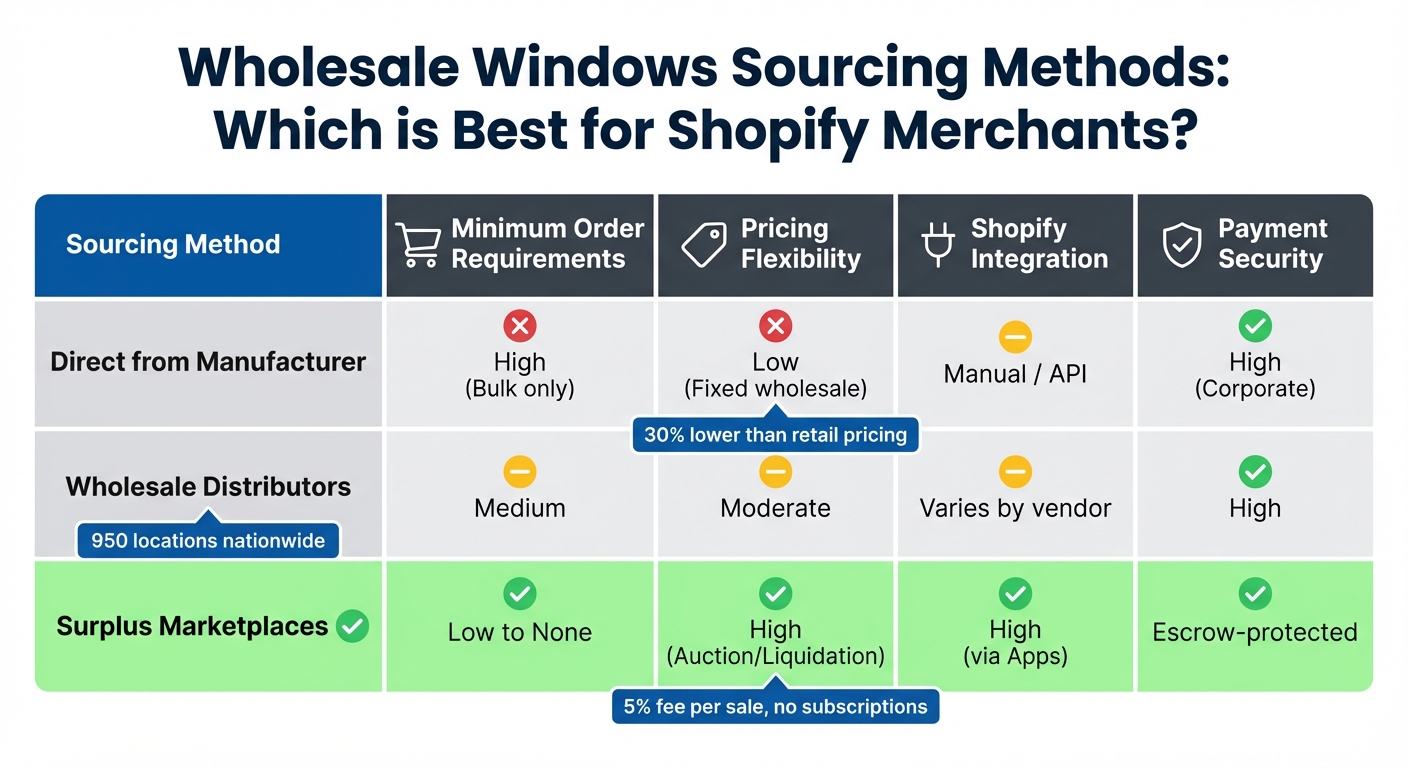
Wholesale Windows Sourcing Methods Comparison for Shopify Merchants
Selecting the right sourcing method for wholesale windows can significantly influence your profit margins, inventory flexibility, and overall operations. Shopify merchants generally have three main options: sourcing directly from manufacturers, working with distributors, or leveraging surplus marketplaces. Each option has its own set of trade-offs that can impact your business.
Sourcing Options Comparison Table
Here's a quick breakdown of how these sourcing methods compare in terms of minimum order requirements (MOQ), pricing flexibility, Shopify integration, and payment security:
| Sourcing Method | Minimum Order Requirements | Pricing Flexibility | Shopify Integration | Payment Security |
|---|---|---|---|---|
| Direct from Manufacturer | High (Bulk only) | Low (Fixed wholesale) | Manual / API | High (Corporate) |
| Wholesale Distributors | Medium | Moderate | Varies by vendor | High |
| Surplus Marketplaces | Low to None | High (Auction/Liquidation) | High (via Apps) | Escrow-protected |
Manufacturers often provide the lowest per-unit costs - up to 30% below retail pricing - but typically require large bulk orders and longer lead times. Wholesale distributors, such as ABC Supply, which operates nearly 950 locations across the U.S., strike a balance with moderate MOQs and quicker delivery times. On the other hand, surplus marketplaces cater to merchants needing immediate stock without committing to bulk purchases, making them an attractive option for Shopify sellers.
Why Surplus Marketplaces Work Best for Shopify Merchants
Surplus marketplaces shine because they align perfectly with the needs of Shopify merchants. Unlike traditional sourcing methods, these platforms focus on quick inventory turnover and flexible purchasing options. This makes them especially useful for merchants looking to test new products or manage seasonal inventory shifts without tying up large amounts of capital.
One of the standout features of surplus marketplaces is their low or nonexistent MOQ. Instead of requiring large upfront commitments, merchants can purchase inventory as needed, offering flexibility that’s hard to find with manufacturers or distributors. Additionally, surplus platforms allow merchants to list unsold products and connect with buyers seeking discounted deals, creating a dynamic ecosystem that benefits both sellers and buyers.
Platforms like Forthclear remove the subscription fees often associated with traditional wholesale directories. Instead, they charge a simple 5% platform fee per sale. Transactions are escrow-protected through Stripe, ensuring funds are securely held until delivery is confirmed. This offers peace of mind for both parties involved.
The self-service nature of surplus marketplaces is another major draw. Today’s B2B buyers are increasingly independent - 65% of them prefer completing high-value transactions online without engaging sales representatives, compared to just 24% who rely on reps. For Shopify merchants, this model integrates seamlessly with their existing operations. By managing retail and surplus inventory from a single dashboard, merchants can simplify workflows and maintain control over their stock, all while capitalizing on the flexibility and speed surplus marketplaces provide.
Conclusion
Managing wholesale windows inventory as a Shopify merchant doesn’t have to mean dealing with bulk orders or outdated stock. By opting for sourcing methods with low MOQs, flexible pricing, and quick turnover, you can sidestep the usual hurdles.
Surplus marketplaces, for example, simplify wholesale operations. They help you avoid a 30% markup while still maintaining manufacturer warranties. Instead of committing to costly subscription fees that cut into your margins before you’ve even made a sale, platforms like Forthclear offer a more practical approach - charging only a 5% fee per sale, with no cost to list.
With tools like a unified dashboard, auto-detection for dead stock, and secure Stripe escrow payments, you can manage both retail and surplus inventory seamlessly. This setup allows you to turn stagnant stock into revenue without upfront costs, while connecting directly with verified bulk buyers. It’s a smarter way to handle seasonal overstock or experiment with new product lines without the risk of large order commitments.
If you’re ready to move surplus windows and unlock new revenue opportunities, check out forthclear.io. Listing is free, and you’ll only pay a 5% fee when you make a sale.
FAQs
Where can I buy wholesale windows for contractors?
Advanced Window and Door Distribution provides wholesale Pella Windows and Doors, offering prices that are often up to 30% lower than retail. This pricing structure is tailored specifically for contractors and consumers managing large-scale projects. By purchasing directly, you can enjoy substantial savings while ensuring access to high-quality products.
What’s the price difference between wholesale windows and retail?
Wholesale windows often cost around 30% less than their retail counterparts. This price reduction is due to purchasing directly from manufacturers or distributors, cutting out the retail markup. These savings are particularly advantageous for contractors and merchants managing large-scale projects.
How do I verify a wholesale window supplier is legit?
When evaluating a wholesale window supplier, there are a few key things to keep in mind to ensure they’re legitimate. First, check for clear pricing structures - transparent costs often indicate a trustworthy business. Also, look for detailed contact information and proof that they work directly with manufacturers or authorized distributors. This can help confirm they’re not a middleman adding unnecessary markups.
Don’t forget to review customer feedback and trust scores. These can give you a sense of the supplier’s reliability and product quality. Be cautious of suppliers that make vague claims or have unclear policies - these can be red flags. Verifying these details can save you time and money while ensuring you get quality products at true wholesale prices.