Wholesale Margin Calculator
Enter your cost price and target margin — this calculator gives you the exact wholesale price and minimum order value to stay profitable across different buyer tiers.
Hylke Reitsma is co-founder of Forthsuite and a supply chain specialist with 8+ years of hands-on experience at Shell, Verisure, and Stryker. He holds an MSc in Supply Chain Management from the University of Groningen and writes practical guides to help e-commerce teams run leaner, faster supply chains. Selected by Replit as 1 of 20 founders for the inaugural Race to Revenue Cohort #1 (2026) and certified as a Replit Platform Builder.
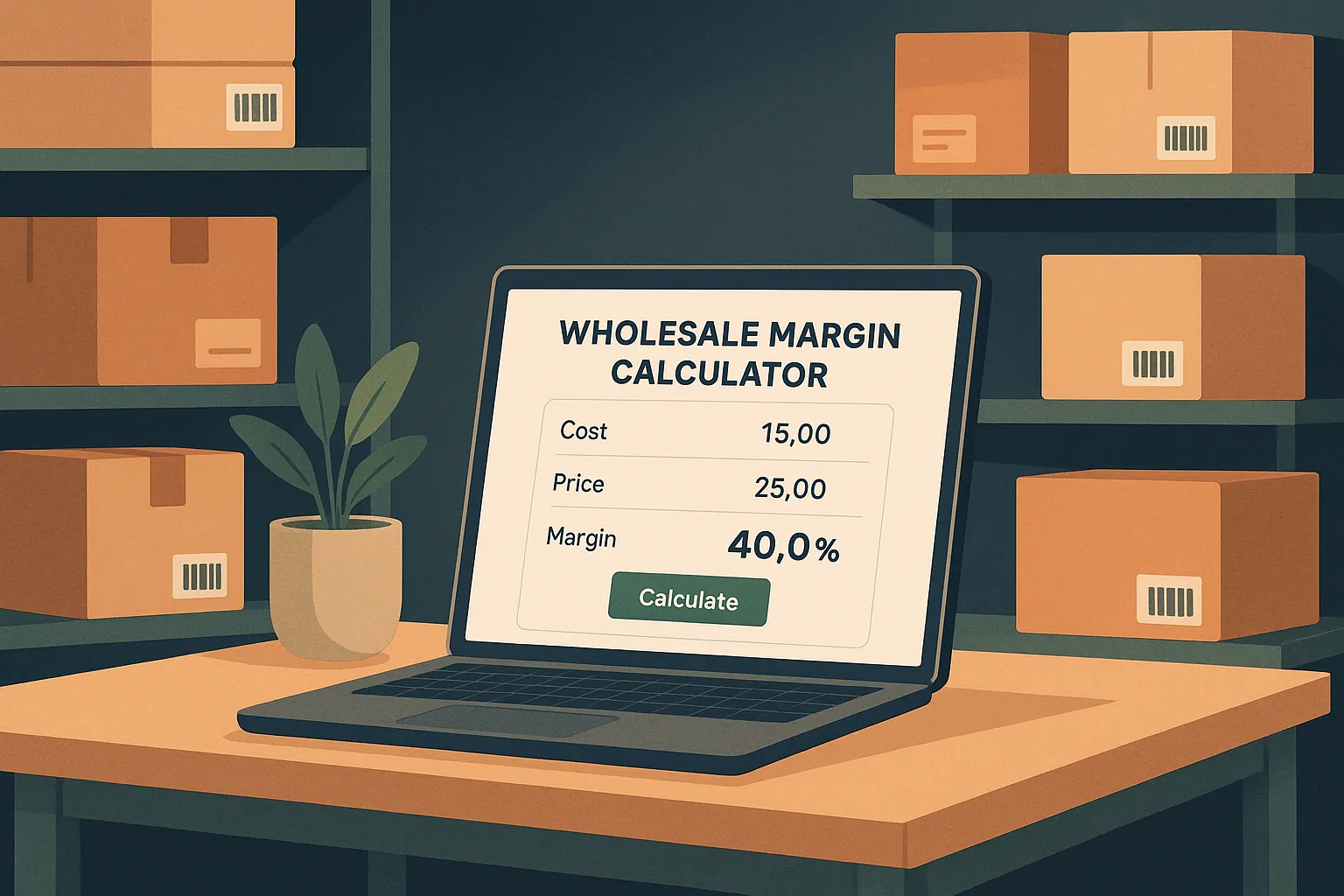
Wholesale Margin Calculator
TL;DR: A wholesale margin calculator helps you quickly determine the profitability of bulk deals by factoring in costs, sales prices, and overheads to reveal your true margins. Forthclear helps Shopify operators maximize returns on excess inventory that's eating into those margins by liquidating overstock and deadstock through secondary-market channels.
Maximize Profits with a Wholesale Margin Calculator
Running a wholesale business means juggling a lot of numbers—costs, sales, overheads, and more. Figuring out if a bulk deal is actually worth your time can be a headache without the right tools. That’s where a tool for calculating wholesale profitability comes in handy. It takes the guesswork out of pricing and helps you see the full financial picture in just a few clicks.
Why Profit Margins Matter in Bulk Sales
Every wholesaler knows that volume doesn’t always equal profit. You might move a ton of product, but if your costs eat up the revenue, you’re spinning your wheels. A smart calculation tool lets you input key data like unit costs, selling prices, and extra fees to reveal your true margins. Beyond just numbers, it offers insights into whether your strategy is sustainable. Are you pricing too low? Are overheads sneaking up on you? These answers can shape smarter decisions.
Take Control of Your Business
Don’t leave your profits to chance. Using a dedicated tool to analyze bulk sales margins empowers you to tweak pricing, cut unnecessary costs, and focus on deals that truly pay off. Whether you’re a seasoned wholesaler or just scaling up, having this kind of clarity is invaluable for long-term growth.
How to Use the Wholesale Margin Calculator: A Worked Example
Let's walk through a real-world scenario that many Shopify merchants face: clearing end-of-season inventory through a wholesale buyer.
The Scenario
You have 100 units of winter jackets sitting in your warehouse. Your cost price (what you paid your supplier) is $22 per unit. A wholesale buyer offers to purchase the entire lot at $38 per unit.
Enter these figures into the calculator above:
- Cost Price: $22
- Selling Price: $38
- Quantity: 100 units
Understanding Your Results
Gross Margin: 42.1% — Calculated as (Selling Price - Cost Price) ÷ Selling Price, or ($38 - $22) ÷ $38. This tells you what percentage of the sale price is profit.
Markup: 72.7% — Calculated as (Selling Price - Cost Price) ÷ Cost Price, or ($38 - $22) ÷ $22. This shows how much you've added on top of your cost.
Total Profit: $1,600 — Your gross profit across all 100 units.
When to Use Margin vs Markup
Use margin percentage when communicating with buyers, banks, or investors. Financial statements and industry benchmarks typically reference margin because it shows profit as a proportion of revenue.
Use markup percentage when setting prices or evaluating supplier negotiations. Markup helps you understand how much room you have to adjust pricing while staying profitable.
Note: A healthy wholesale margin typically falls between 30–50%. If your margins drop below 25%, most third-party logistics providers (3PLs) become unprofitable to use — the fulfillment costs eat into what little profit remains. At that point, you're better off selling in bulk directly to a clearance buyer who handles their own logistics.
Wholesale Margin vs Retail Margin: What Shopify Sellers Need to Know
Understanding the difference between wholesale and retail margins is critical for Shopify merchants who sell through multiple channels — or who are considering wholesale as a clearance strategy for the first time.
The Margin Gap
Wholesale margins typically range from 30–50%, while retail margins run higher at 40–70%. This gap exists because retailers take on additional costs: storefronts, customer service, marketing, and returns handling. When you sell wholesale, you're trading margin for volume and simplicity.
How Double Margin Stacking Works
When a product moves from brand to consumer through a retailer, margins stack at each level. For example: you sell a jacket to a retailer at $38 (your 40% margin on a $22 cost). The retailer then sells it to consumers at $85 (their 55% margin). The final retail price reflects both businesses taking their cut.
This is why wholesale buyers expect significant discounts — they need room to apply their own margin and still price competitively.
Acceptable Floors for Clearance Sales
When moving excess inventory, Shopify merchants often accept margins well below their standard thresholds. The goal shifts from maximizing profit to recovering capital and freeing up warehouse space. Here's what realistic margins look like across inventory types:
| Inventory Type | Typical Margin Range | Accept as Low As (Clearance) |
|---|---|---|
| New season stock | 40–60% | 30% |
| End-of-season | 25–40% | 15% |
| Excess/overstock | 15–30% | 10% |
| Damaged/returned | 5–15% | Break-even |
Knowing your acceptable floor before entering negotiations prevents emotional decision-making and helps you walk away from deals that don't make financial sense.
5 Ways to Improve Wholesale Margins Before You Liquidate
Before accepting rock-bottom liquidation prices, try these strategies to preserve more of your margins on excess inventory.
1. Repackage and Rebundle
Combine slow-moving SKUs into themed bundles or variety packs. A "Winter Essentials Kit" that pairs unsold gloves with scarves can command a higher per-unit price than selling each item separately at clearance rates.
2. Negotiate Early Payment Terms
Offer wholesale buyers a 2–3% discount for payment within 10 days instead of net-30. You'll sacrifice a small percentage but gain faster cash flow and eliminate accounts receivable risk — often a net positive for your business.
3. Use B2B Platforms Before Liquidators
Traditional liquidators offer pennies on the dollar because they're buying blind and assuming risk. B2B clearance platforms like Forthclear connect you directly with wholesale buyers who understand your product category, typically yielding 15–30% higher recovery rates than pure liquidation.
4. Reduce Storage Costs to Improve Net Margin
Every month inventory sits in a warehouse, your effective margin shrinks. Calculate your true carrying costs (storage fees, insurance, opportunity cost) and factor these into your minimum acceptable price. Sometimes a faster sale at a lower margin beats holding out for a better offer.
5. Use Auction-Style Pricing for High-Velocity Clearance
For large quantities, consider time-limited auction pricing where the price drops incrementally until a buyer commits. This creates urgency and often lands you a better price than a static "best offer" listing.
FAQs
What counts as a 'healthy' profit margin for wholesale?
Generally, a margin above 20% is considered solid for wholesale businesses, as it gives you room to cover unexpected costs and still turn a profit. Below 10% can be risky, especially if you’re dealing with fluctuating expenses or tight competition. That said, it depends on your industry—some niches operate on razor-thin margins but make up for it with high volume. Use this tool to benchmark your numbers and see where you stand!
Can I include multiple overhead costs in the calculator?
Right now, the tool lets you input a single overhead cost per unit, which could be a combined figure for things like warehousing, transport, or packaging. Just add up those costs manually before entering them. We’re working on a future update to allow multiple overhead fields for even more precision, so stay tuned for that!
What if I enter negative numbers by mistake?
No worries! Our tool has built-in error handling to catch negative inputs for costs, prices, or units. If you accidentally type in a negative value, you’ll get a clear warning message telling you to correct it. This ensures your calculations stay accurate and meaningful, so you’re not left scratching your head over weird results.
About the Author

Hylke Reitsma is co-founder of Forthsuite and a supply chain specialist with 8+ years of hands-on experience at Shell, Verisure, and Stryker. He holds an MSc in Supply Chain Management from the University of Groningen and writes practical guides to help e-commerce teams run leaner, faster supply chains. Selected by Replit as 1 of 20 founders for the inaugural Race to Revenue Cohort #1 (2026) and certified as a Replit Platform Builder.
LinkedIn